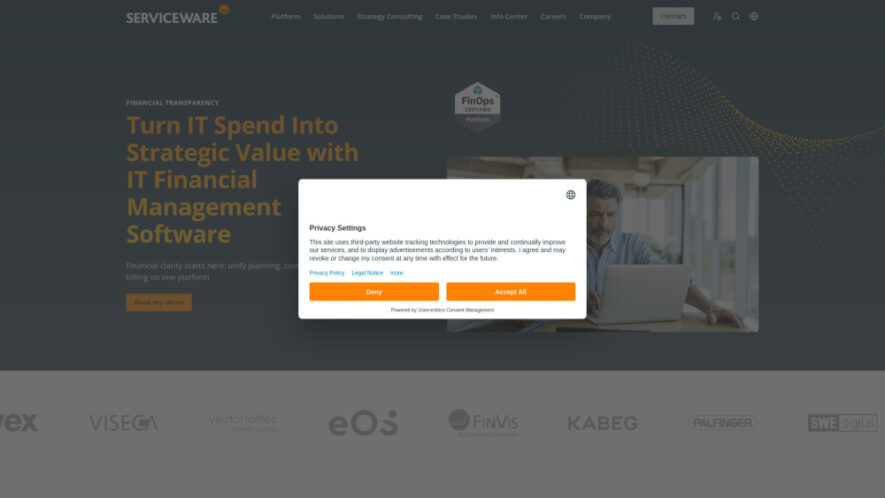
Serviceware Financial is an IT Financial Management platform that helps enterprises control, understand, and optimize technology spending. It unifies planning, costing, billing, benchmarking, and service management within one governed environment. Organizations can improve cost transparency, automate financial processes, forecast budgets, manage vendors, and allocate IT expenses...
Serviceware Financial is an IT Financial Management platform that helps enterprises control, understand, and optimize technology spending. It unifies planning, costing, billing, benchmarking, and service management within one governed environment. Organizations can improve cost transparency, automate financial processes, forecast budgets, manage vendors, and allocate IT expenses more effectively. The platform also connects financial information with business priorities, helping IT teams demonstrate value, improve accountability, and make smarter investment decisions across the organization.
Cost Transparency Provides detailed visibility into IT costs, services, resources, and spending patterns.
Billing Automation Automates showback and chargeback processes while improving billing accuracy and auditability.
Financial Planning Supports structured IT budgeting, forecasting, planning, and financial scenario analysis.
Cost Benchmarking Compares IT spending against internal performance data and relevant industry benchmarks.
Vendor Management Centralizes supplier costs, contracts, renewals, and financial information for better oversight.
Transfer Pricing Supports automated markups, documentation, and compliant transfer pricing across global operations.
Shared Services Helps standardize IT services while transparently allocating costs across business functions.
Service Catalog Tracks IT services throughout their lifecycle, supporting governance, optimization, and financial accountability.
You Got Questions,We Got Answers
What Is IT Financial Management And Why Does It Matter?
IT Financial Management provides a structured way to manage technology costs, budgets, and business value. It helps organizations improve financial visibility, control spending, connect IT investments with strategic priorities, and make better decisions using accurate financial information.
How Does Serviceware Financial Support Enterprise ITFM Processes?
Serviceware Financial connects planning, costing, billing, benchmarking, and shared services within one governed platform. It can integrate with ERP, ITSM, BI, and cloud systems, helping enterprises manage their complete IT financial lifecycle more efficiently.
How Can Serviceware Financial Improve IT Cost Transparency?
The platform provides centralized visibility into IT services, costs, suppliers, budgets, and financial allocations. This helps organizations understand where technology spending occurs, identify inefficiencies, and communicate IT costs more clearly across business departments.
Does Serviceware Financial Support Showback And Chargeback Processes?
Yes, Serviceware Financial supports automated showback and chargeback processes with greater consistency and auditability. Organizations can transparently allocate technology costs to business units while reducing manual billing activities and improving financial accountability across departments.
Can Serviceware Financial Help With IT Budgeting And Forecasting?
Serviceware Financial supports IT planning, budgeting, forecasting, and financial scenario analysis. These capabilities help organizations anticipate technology costs, compare financial plans, evaluate potential investments, and align available IT resources with changing business priorities.
Does Serviceware Financial Provide IT Cost Benchmarking Capabilities?
Yes, the platform supports IT cost benchmarking by comparing budgets and spending against internal information and relevant peer data. Organizations can use these insights to identify unusual costs, evaluate efficiency, and discover potential opportunities for optimization.
How Does Serviceware Financial Help Manage IT Vendors?
Serviceware Financial provides centralized visibility into suppliers, contracts, costs, and renewal information. This enables organizations to monitor vendor-related spending, improve contract oversight, identify financial commitments, and make more informed decisions about technology suppliers.
How Long Does Serviceware Financial Implementation Typically Take?
Implementation timelines depend on organizational size, requirements, integrations, and existing financial processes. Serviceware indicates that many enterprises can achieve measurable transparency within one planning cycle, although complete deployment may require additional configuration and integration work.
Use cases
Optimization
Identifies inefficient IT spending and redirects resources toward higher-value business initiatives.
Planning
Unifies IT budgets, forecasts, financial plans, and scenarios for better investment decisions.
Billing
Automates showback and chargeback processes, reducing manual work while maintaining financial auditability.
Benchmarking
Compares technology budgets with internal and peer data to identify optimization opportunities.
Vendors
Centralizes supplier expenses, contracts, renewals, and financial commitments for improved vendor management.
Compliance
Standardizes transfer pricing calculations, markups, and documentation to support global financial compliance requirements.
Allocation
Provides transparent IT cost allocation across departments, business units, and shared service functions.
Governance
Tracks services from creation through retirement while improving financial control, optimization, and accountability.
Traffic and Engagement
Jun 2026 - Aug 2026
World wide
Monthly visitors (August)
16.8k
Page/Visit
2.24
Visit Duration
1m 1s
Bounce Rate
44.06%
Pricing
Free
Contact for Pricing
Serviceware Financial Embeds
Copied!
Let your community know you're live on Skillcurb! Just drop a badge on your site’s homepage with just a few clicks. Showcasing the badge helps increase your visibility and connects you with users actively exploring top AI tools.