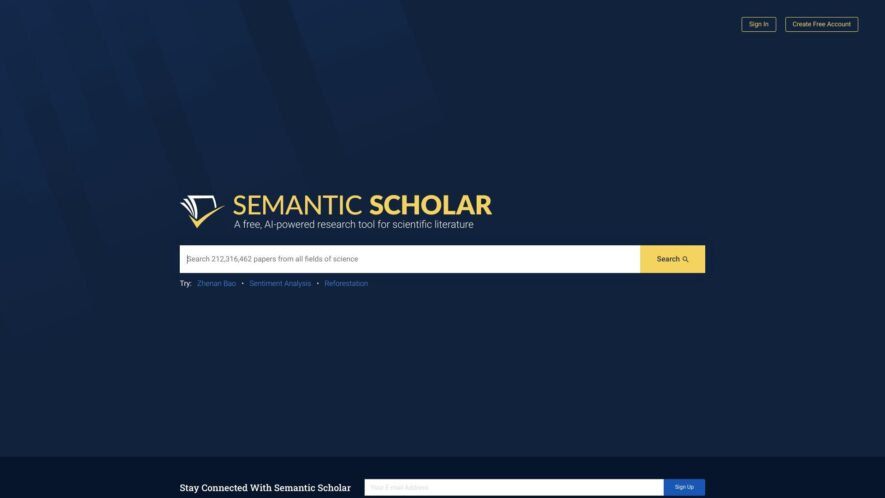
Semantic Scholar is a free online platform that indexes and analyzes academic papers, providing a comprehensive search engine for researchers, scientists, and students to discover and explore scholarly literature, including papers, authors, institutions, and topics, with features such as citation metrics, co-authorship networks, and paper recommendations,...
Semantic Scholar is a free online platform that indexes and analyzes academic papers, providing a comprehensive search engine for researchers, scientists, and students to discover and explore scholarly literature, including papers, authors, institutions, and topics, with features such as citation metrics, co-authorship networks, and paper recommendations, aiming to accelerate scientific progress by making it easier to find, understand, and use scholarly research.
Searches academic papers and publications from various sources and databases.
Provides summaries and abstracts of research papers and articles.
Allows filtering and sorting of search results by relevance and date.
Displays citations and references for each research paper and article.
Offers a list of related papers and articles based on search queries.
Enables users to save and organize papers in personal libraries.
Supports collaboration by allowing users to share papers and libraries.
Provides analytics and insights on research trends and paper impact.
You Got Questions,We Got Answers
What is Semantic Scholar?
Semantic Scholar is a free academic search engine that indexes papers, authors, and institutions, providing features like citation metrics, paper recommendations, and a knowledge graph to facilitate discovery and exploration of academic literature.
What papers are included?
Semantic Scholar indexes a vast corpus of academic papers, theses, and dissertations from various fields, including but not limited to computer science, physics, biology, medicine, and social sciences, sourced from reputable publishers and repositories.
How does it rank papers?
The platform employs a ranking system based on the papers' relevance, citation counts, and other metrics, allowing users to quickly identify influential and highly cited research in their area of interest.
Can I download papers?
While Semantic Scholar does not directly host or provide downloadable copies of papers, it offers links to external sources, such as arXiv, DOAJ, or authors' personal websites, where papers might be available for download, depending on the authors' or publishers' policies.
Can I create an account?
Yes, users can create a free account, which enables features like saving papers and authors to a personal library, setting up alerts for new papers from specific authors or topics, and receiving personalized recommendations.
How often is the database updated?
Semantic Scholar's database is continuously updated, with new papers and metadata added daily, and the algorithmic models re-trained regularly to ensure the accuracy and relevance of search results and recommendations.
Can I use it for commercial purposes?
While Semantic Scholar is primarily intended for academic and educational use, commercial entities can utilize the data and API, subject to specific terms and conditions, which can be found on the website or by contacting the support team.
Is Semantic Scholar open-source?
The platform's codebase is not entirely open-source; however, certain components, such as the academic paper parser, are open-sourced, and the development team actively contributes to and participates in relevant open-source initiatives.
Use cases
Healthcare
Researchers at a leading cancer center use Semantic Scholar to identify and analyze the latest studies on immunotherapy, informing their development of more effective treatment plans and improving patient outcomes
Finance
Investment firms utilize Semantic Scholar to stay up-to-date on the latest research in econometrics and financial modeling, enabling them to make more accurate predictions and optimize their portfolios
Retail
E-commerce companies leverage Semantic Scholar to analyze consumer behavior studies and identify trends, allowing them to create targeted marketing campaigns and improve customer satisfaction
Manufacturing
Industrial companies use Semantic Scholar to access research on advanced materials and manufacturing techniques, informing the development of more efficient and sustainable production processes
Marketing
Marketing agencies employ Semantic Scholar to stay current on the latest research in consumer psychology and behavioral economics, enabling them to craft more persuasive and effective advertising campaigns
Education
Educators use Semantic Scholar to access a vast repository of academic papers and research, facilitating the development of more informed and effective curricula and pedagogical approaches
Traffic and Engagement
Feb 2026 - Apr 2026
World wide
Monthly visitors (April)
5.2m
Page/Visit
3.3
Visit Duration
2m 37s
Bounce Rate
0.5%
Pricing
Free
$0
Semantic Scholar Embeds
Copied!
Let your community know you're live on Skillcurb! Just drop a badge on your site’s homepage with just a few clicks. Showcasing the badge helps increase your visibility and connects you with users actively exploring top AI tools.