Ponder AI is an AI-powered thinking and research workspace that helps knowledge workers organize information, explore ideas, and build clear insights visually. Users can ask questions, upload documents, brainstorm on an infinite canvas, and connect related concepts through visual knowledge maps. Its Ponder Agent helps investigate...
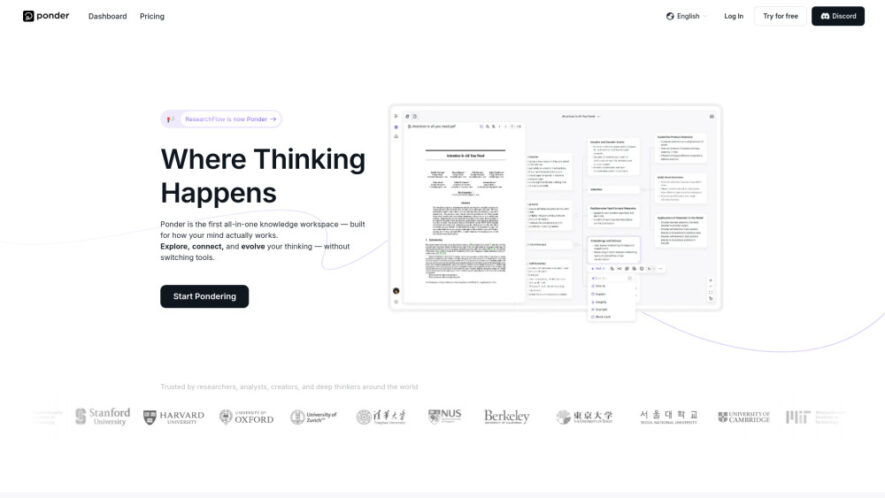
Ponder AI is an AI-powered thinking and research workspace that helps knowledge workers organize information, explore ideas, and build clear insights visually. Users can ask questions, upload documents, brainstorm on an infinite canvas, and connect related concepts through visual knowledge maps. Its Ponder Agent helps investigate different perspectives, challenge assumptions, discover connections, and turn complex information into organized, explainable work and deliverables.
Smart research assistant helps explore questions, gather insights, and connect information.
AI-powered mind mapping visualizes ideas through an expanding infinite canvas workspace.
Ponder Agent guides exploration, challenges assumptions, and suggests new research directions.
All-in-one workspace combines research, notes, conversations, brainstorming, and knowledge organization.
Visual knowledge maps reveal relationships between ideas while supporting detailed exploration.
Upload PDFs, documents, and notes to build knowledge around existing research.
Organize scattered information into structured insights and comprehensive knowledge maps.
Create polished deliverables directly from organized research and visual thinking workflows.
You Got Questions,We Got Answers
What Is Ponder AI Mainly Used For By Knowledge Workers?
Ponder AI helps knowledge workers research complex topics, organize information, analyze ideas, prepare presentations, and make strategic decisions. It combines AI conversations, visual mapping, and knowledge organization within one integrated workspace.
How Is Ponder AI Different From ChatGPT And Claude?
Traditional AI chat tools primarily provide answers within linear conversations. Ponder AI emphasizes visual thinking, turning ideas into connected nodes on an infinite canvas so users can explore relationships, branches, and broader context.
Who Can Benefit Most From Using Ponder AI?
Ponder AI is designed for analysts, consultants, researchers, academics, strategists, and professionals handling complex knowledge work. Anyone needing to synthesize information, explore ideas, and make well-supported decisions can benefit.
Do Users Need Technical Skills To Start Using Ponder AI?
No, Ponder AI is designed for non-technical users. You can begin with a question or upload documents, while the AI helps guide exploration. Its visual interface makes organizing ideas accessible without specialized technical knowledge.
Can Ponder AI Work With Personal Documents And Research Files?
Yes, users can upload PDFs, documents, and notes directly into Ponder AI. These materials can become part of the workspace, allowing users to organize existing research and build connected knowledge maps around their information.
How Does Ponder AI Help Organize Complex Information Visually?
Ponder AI represents ideas as visual nodes on an infinite canvas, allowing users to see relationships and connections. This visual approach helps transform scattered information into organized knowledge while supporting deeper exploration of individual topics.
Can Ponder AI Help With Business And Strategic Recommendations?
Yes, Ponder AI can support business research, strategic analysis, investment theses, and recommendation development. Users can explore evidence, challenge assumptions, connect relevant information, and organize their reasoning into clearer, defensible conclusions.
Can Users Create Deliverables Directly From Their Ponder Workspace?
Yes, Ponder AI allows users to organize research and thinking before creating or exporting deliverables. This helps transform connected ideas, source information, and structured insights into presentations, recommendations, and other professional outputs.
Use cases
Research
Research complex topics by connecting multiple sources and synthesizing information visually.
Presentations
Prepare organized client presentations with clearer thinking, stronger evidence, and structured insights.
Investing
Build investment theses and strategic recommendations using organized research and connected information.
Academics
Organize academic research, literature reviews, sources, and emerging ideas efficiently.
Brainstorming
Explore new business ideas by visually connecting concepts, questions, opportunities, and insights.
Analysis
Make sense of large information volumes by organizing relationships and identifying important patterns.
Strategy
Develop strategic recommendations by exploring assumptions, evidence, alternatives, and connected perspectives.
Decisions
Support high-stakes decisions with structured research, deeper exploration, and defensible reasoning.
Traffic and Engagement
Jun 2026 - Aug 2026
World wide
Monthly visitors (August)
97.2k
Page/Visit
2.24
Visit Duration
1m 12s
Bounce Rate
40.23%
Pricing
Paid
0.081
Ponder AI Embeds
Copied!
Let your community know you're live on Skillcurb! Just drop a badge on your site’s homepage with just a few clicks. Showcasing the badge helps increase your visibility and connects you with users actively exploring top AI tools.