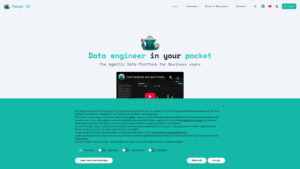
Get MONAI is an open-source framework for healthcare imaging that provides a comprehensive platform for medical image analysis, leveraging AI and machine learning to accelerate research and clinical applications, offering a modular architecture, extensible APIs, and a large community-driven ecosystem, enabling developers to build, train, and...
Get MONAI is an open-source framework for healthcare imaging that provides a comprehensive platform for medical image analysis, leveraging AI and machine learning to accelerate research and clinical applications, offering a modular architecture, extensible APIs, and a large community-driven ecosystem, enabling developers to build, train, and deploy medical imaging models and applications, with a focus on reproducibility, scalability, and interoperability, and supporting various imaging modalities, including MRI, CT, and ultrasound.
Automated medical image annotation with AI-powered segmentation tools.
Supports various medical imaging modalities, including MRI, CT, and X-ray.
Integrates with existing workflows and infrastructure for seamless collaboration.
Real-time collaboration and feedback mechanisms for efficient annotation.
Advanced data analytics and visualization for actionable insights.
Compliant with regulatory requirements, such as HIPAA, for secure data handling.
Customizable workflows and templates for tailored annotation needs.
Scalable architecture for high-volume image annotation and processing.
You Got Questions,We Got Answers
What is MONAI?
MONAI is an open-source AI framework for healthcare, providing a suite of tools and libraries for medical imaging and analysis, enabling researchers and clinicians to develop and deploy AI models efficiently
How does MONAI work?
MONAI works by providing a modular architecture that integrates various components, including data loaders, transforms, and models, allowing users to create, train, and deploy AI models for medical imaging tasks, such as segmentation, detection, and classification
What are MONAI's key features?
MONAI's key features include support for 2D and 3D medical imaging, integration with popular deep learning frameworks, and a modular design that enables customization and extension, making it a versatile tool for healthcare AI development
Is MONAI free to use?
Yes, MONAI is open-source and free to use, with no licensing fees or restrictions, allowing users to access and contribute to the community-driven project, and deploy AI models in their own applications and research
Can I use MONAI for clinical research?
Yes, MONAI is designed for clinical research and provides tools and libraries for medical imaging analysis, enabling researchers to develop and validate AI models for various clinical applications, such as disease diagnosis and treatment planning
How do I get started with MONAI?
To get started with MONAI, users can access the documentation and tutorials on the official website, which provide step-by-step guides and examples for installing, configuring, and using MONAI for medical imaging AI development
Is MONAI compatible with my operating system?
MONAI is compatible with Windows, macOS, and Linux operating systems, and can be installed using popular package managers such as pip and conda, making it accessible to a wide range of users and environments
Can I contribute to MONAI's development?
Yes, MONAI is an open-source project that welcomes contributions from the community, including code contributions, bug reports, and documentation improvements, allowing users to participate in shaping the future of healthcare AI development
Use cases
Here are the six real-world use cases for MONAI: Radiology
MONAI's AI-powered segmentation enables radiologists to accurately identify tumors and organs in medical images, streamlining diagnosis and treatment planning
Pharma
MONAI's image analysis capabilities help pharmaceutical companies accelerate drug development by quantifying disease progression and treatment response in clinical trials
Agriculture
MONAI's computer vision technology allows farmers to detect crop diseases and pests, enabling early intervention and reducing chemical usage
Robotics
MONAI's 3D reconstruction capabilities enable robots to navigate complex environments and perform tasks such as object manipulation and scene understanding
Manufacturing
MONAI's quality control solution uses AI-powered image analysis to detect defects in products, reducing waste and improving production efficiency
Neurology
MONAI's brain image analysis helps neurologists diagnose and monitor neurological disorders such as Alzheimer's and Parkinson's, improving patient outcomes
Traffic and Engagement
Apr 2026 - Jun 2026
World wide
Monthly visitors (June)
4.2k
Page/Visit
1.8
Visit Duration
11s
Bounce Rate
0.6%
Pricing
Freemium
$2.99
MonAi – AI powered expense tracker Embeds
Copied!
Let your community know you're live on Skillcurb! Just drop a badge on your site’s homepage with just a few clicks. Showcasing the badge helps increase your visibility and connects you with users actively exploring top AI tools.