LTX-2 by Lightricks is a production-ready, open-source AI foundation model for generating synchronized 4K video and audio. It supports text-to-video and image-to-video creation, producing high-quality clips with dialogue, music, and ambient sounds. Built on an advanced Diffusion Transformer architecture, LTX-2 delivers fast performance, local deployment flexibility,...
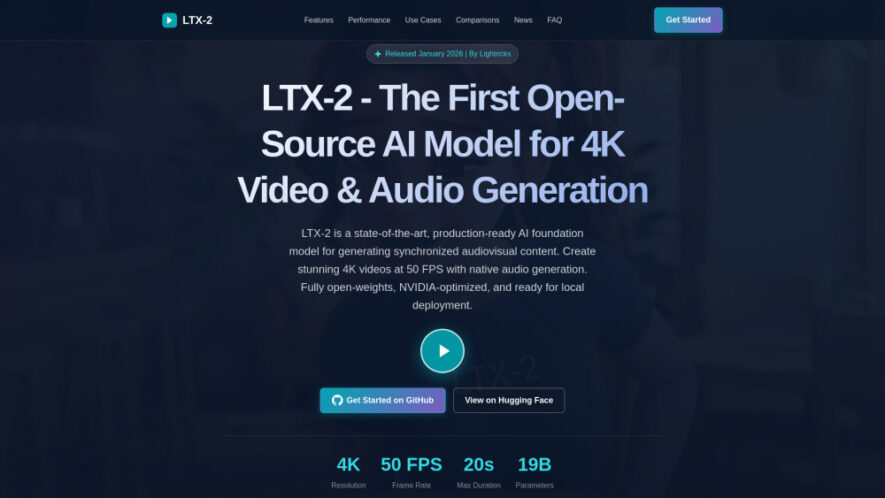
LTX-2 by Lightricks is a production-ready, open-source AI foundation model for generating synchronized 4K video and audio. It supports text-to-video and image-to-video creation, producing high-quality clips with dialogue, music, and ambient sounds. Built on an advanced Diffusion Transformer architecture, LTX-2 delivers fast performance, local deployment flexibility, and commercial-friendly licensing, making it ideal for creators, developers, researchers, filmmakers, and AI professionals.
Generate synchronized 4K videos with realistic audio using advanced AI technology.
Support text-to-video and image-to-video generation with impressive visual consistency throughout.
Produce high-quality clips featuring dialogue, ambient sounds, and background music seamlessly.
Open-source architecture includes model weights, training code, and inference pipeline access.
Generate videos up to twenty seconds with smooth temporal coherence and realism.
Optimized for NVIDIA GPUs delivering faster inference and improved memory efficiency consistently.
Deploy locally or through cloud platforms for flexible AI video production.
Commercial-friendly Apache license enables customization, fine-tuning, and unrestricted development workflows.
You Got Questions,We Got Answers
1. What makes LTX-2 different from other AI video models?
LTX-2 is the first fully open-source AI model supporting synchronized 4K video and audio generation, offering model weights, training code, and commercial-friendly licensing for complete customization and deployment flexibility.
2. Can LTX-2 generate both video and synchronized audio together?
Yes, LTX-2 creates synchronized audiovisual content by generating realistic videos alongside dialogue, ambient sounds, and background music, delivering cohesive multimedia outputs from a single AI model.
3. Does LTX-2 support text-to-video and image-to-video generation?
Yes, users can generate videos from detailed text prompts or transform static images into dynamic video sequences with synchronized audio and smooth temporal consistency.
4. What hardware is recommended for running LTX-2 efficiently?
LTX-2 performs best with NVIDIA RTX 40 or 50 series GPUs featuring at least 16GB VRAM, though cloud deployment options provide additional accessibility without local hardware.
5. Is LTX-2 completely open-source for commercial development projects?
Yes, LTX-2 is released under the Apache 2.0 license, allowing commercial and non-commercial usage, code modifications, model fine-tuning, and unrestricted application development.
6. How long can videos generated by LTX-2 be currently?
The model supports generating high-quality video clips up to approximately twenty seconds while maintaining synchronized audio, visual consistency, and realistic scene transitions throughout the sequence.
7. Can developers deploy LTX-2 locally or through cloud services?
Yes, developers can deploy LTX-2 locally using the open-source resources or access it through supported cloud platforms for scalable AI video generation workflows.
8. Who should use LTX-2 for creative and development projects?
Filmmakers, researchers, AI developers, educators, content creators, software engineers, and marketing professionals can leverage LTX-2 for producing high-quality synchronized audiovisual content efficiently.
Use cases
Content
Create engaging marketing videos, stock footage, and social media content with synchronized audio.
Filmmaking
Develop storyboards, pre-visualizations, and cinematic concept videos before full-scale production begins.
Animation
Generate animated scenes, visual references, and creative sequences for production planning efficiently.
Education
Produce instructional videos, educational simulations, and interactive learning materials with realistic audiovisual outputs.
Research
Support AI research, synthetic dataset generation, and machine learning experimentation with advanced video models.
Advertising
Design promotional videos, branded campaigns, and commercial advertisements using AI-powered content generation.
Development
Integrate open-source AI video generation into custom applications and creative software workflows.
Prototyping
Quickly transform ideas into realistic audiovisual prototypes for testing and creative presentations.
Pricing
Free
$0
LTX-2 by Lightricks Embeds
Copied!
Let your community know you're live on Skillcurb! Just drop a badge on your site’s homepage with just a few clicks. Showcasing the badge helps increase your visibility and connects you with users actively exploring top AI tools.