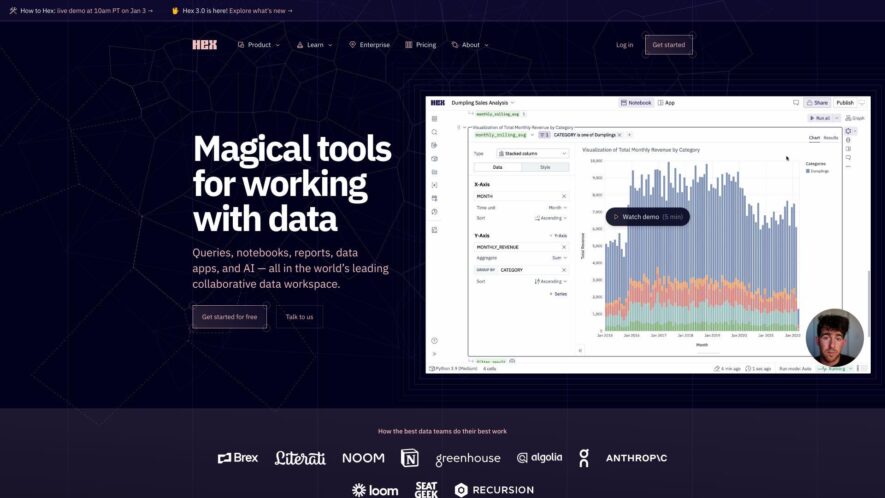
Hex is an AI-powered collaborative data platform that enables teams to explore, analyze, and share data effortlessly. By integrating notebooks, SQL, and no-code tools, it streamlines the data workflow and supports real-time collaboration. Hex allows users to build interactive data apps, visualize insights, and automate reporting...
Hex is an AI-powered collaborative data platform that enables teams to explore, analyze, and share data effortlessly. By integrating notebooks, SQL, and no-code tools, it streamlines the data workflow and supports real-time collaboration. Hex allows users to build interactive data apps, visualize insights, and automate reporting processes. Ideal for data scientists, analysts, and business teams seeking to make data-driven decisions efficiently without switching between multiple tools or requiring extensive technical expertise.
Integrates SQL, Python, R, and AI for data operations
Automates query generation and visualization using AI capabilities
Offers real-time feedback and reusable components for team collaboration
Allows creation of interactive data apps and dashboards
Provides a modular, notebook-based interface for data exploration
Supports connections to data warehouses and cloud storage solutions
Enables building interactive data apps with a drag-and-drop UI.
Offers a powerful AI assistant to help you generate code.
You Got Questions,We Got Answers
What is Hex?
Hex appears to be a collaborative data workspace that combines the functionality of notebooks, data apps, and knowledge bases. It aims to empower data teams to analyze data, build interactive tools, and share their work effectively.
How does Hex work?
Hex likely works by providing a cloud-based environment where users can connect to various data sources, write SQL and Python code in interactive notebooks, build user interfaces for data apps using drag-and-drop components, and organize their work into shareable projects and knowledge bases.
What are the key features of Hex?
Hex seems to offer features such as collaborative notebooks with real-time co-editing, a visual app builder for creating interactive data tools, integrated data connectivity to various databases and data warehouses, version control for data projects, and robust sharing and publishing options.
Who is Hex for?
Hex appears to be designed for data scientists, data analysts, business analysts, and other data professionals who need a unified platform for data exploration, analysis, building data-driven applications, and sharing insights with both technical and non-technical stakeholders.
Does Hex support SQL and Python?
Hex Yes, likely provides first-class support for both SQL and Python, allowing users to leverage the strengths of each language for data querying, manipulation, and analysis within the same collaborative environment.
How does Hex handle collaboration and sharing?
Hex likely offers robust collaboration features, including real-time co-editing of notebooks, shared project workspaces, and the ability to publish notebooks and data apps with different access permissions for internal teams or external stakeholders.
Use cases
Marketing
Marketers utilize Hex to analyze campaign performance metrics and customer behavior by querying data in natural language, enabling swift optimization of marketing strategies without relying on technical teams.
Education
Educational institutions employ Hex to assess student engagement and course effectiveness by querying learning management system data, facilitating data-driven improvements in curriculum and teaching methods.
Retail
Retailers use Hex to monitor sales trends and inventory levels by querying transactional data, allowing for real-time adjustments to stock and promotional strategies to meet consumer demand.
Manufacturing
Manufacturers implement Hex to track production metrics and supply chain efficiency by querying operational data, aiding in the identification of bottlenecks and optimization of manufacturing processes.
Healthcare
Healthcare providers leverage Hex to analyze patient data and treatment outcomes by querying electronic health records, supporting evidence-based clinical decisions and improving patient care.
Finance
Financial institutions adopt Hex to evaluate financial performance and risk by querying financial data, enhancing the ability to make informed investment decisions and manage financial operations effectively.
Traffic and Engagement
Feb 2026 - Apr 2026
World wide
Monthly visitors (April)
446k
Page/Visit
4.7
Visit Duration
5m 31s
Bounce Rate
0.5%
Pricing
Freemium
$36
Hex Embeds
Copied!
Let your community know you're live on Skillcurb! Just drop a badge on your site’s homepage with just a few clicks. Showcasing the badge helps increase your visibility and connects you with users actively exploring top AI tools.