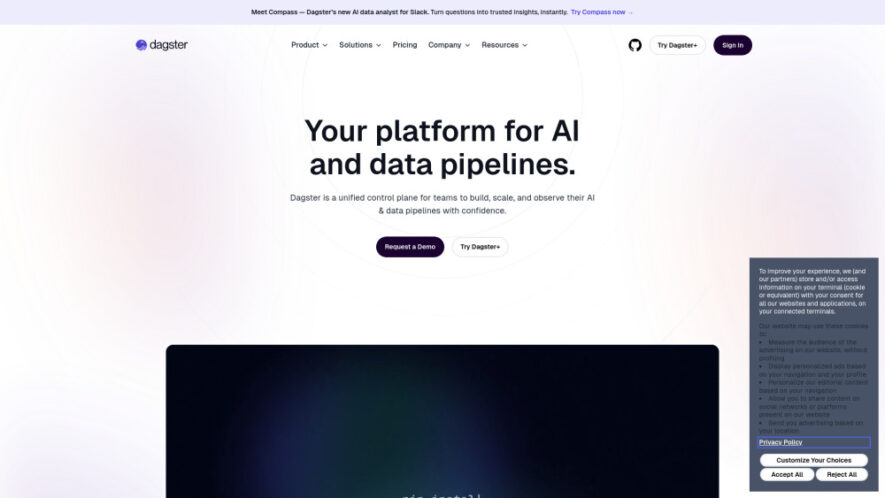
Dagster is a cloud-native data orchestration platform that helps organizations build, schedule, monitor, and manage reliable AI and data pipelines. It combines asset-based orchestration, integrated lineage, observability, testing, and metadata management into a unified workflow. Supporting modern data stacks and cloud services, Dagster enables development teams...
Dagster is a cloud-native data orchestration platform that helps organizations build, schedule, monitor, and manage reliable AI and data pipelines. It combines asset-based orchestration, integrated lineage, observability, testing, and metadata management into a unified workflow. Supporting modern data stacks and cloud services, Dagster enables development teams to improve pipeline reliability, data quality, transparency, and operational efficiency while accelerating the delivery of trustworthy data and AI products.
Cloud-native orchestration simplifies building, scheduling, and monitoring modern data pipelines reliably.
Integrated data lineage provides complete visibility across assets, workflows, and dependencies automatically.
Asset-based orchestration organizes datasets, machine learning models, and business data efficiently.
Built-in observability monitors pipeline performance, health, and execution across environments continuously.
Comprehensive testing framework enables reliable local development and deployment confidence consistently.
Metadata catalog automatically documents assets for improved governance and operational transparency organization-wide.
Cost tracking delivers actionable insights into pipeline usage and infrastructure resource consumption.
Seamlessly integrates with cloud storage, databases, analytics, and machine learning platforms effortlessly.
You Got Questions,We Got Answers
1. What is Dagster and how does it manage data pipelines?
Dagster is a cloud-native data orchestration platform that builds, schedules, monitors, and manages AI and data pipelines. It provides asset-based workflows, observability, lineage tracking, testing, and metadata management within one unified platform.
2. Which types of workflows can organizations build using Dagster?
Dagster supports ETL pipelines, ELT workflows, AI and machine learning processes, analytics pipelines, data modernization projects, and scalable data product development across diverse cloud and enterprise environments.
3. Does Dagster provide integrated data lineage and observability features?
Yes. Dagster automatically tracks data lineage, monitors pipeline execution, documents assets, and provides operational insights that improve transparency, governance, troubleshooting, and overall data platform reliability.
4. Can developers test data pipelines before deploying them into production?
Yes. Dagster includes comprehensive local testing capabilities, branch deployments, and development workflows that allow engineers to validate pipelines before confidently deploying them into staging or production environments.
5. Does Dagster integrate with existing cloud platforms and data tools?
Yes. Dagster integrates with numerous cloud storage services, databases, analytics platforms, and machine learning tools, allowing organizations to work within their existing technology ecosystems without major infrastructure changes.
6. Is there a free trial available for new Dagster users?
Yes. Dagster offers a free 30-day trial that provides access to platform capabilities, enabling teams to evaluate orchestration, monitoring, testing, and workflow management features before subscribing.
7. How does Dagster measure platform usage for billing purposes?
Dagster measures usage through credits based on asset materializations and executed operations. Each completed asset materialization and workflow operation contributes toward overall platform credit consumption for billing calculations.
8. Who benefits most from using the Dagster orchestration platform?
Data engineers, analytics teams, AI developers, machine learning practitioners, and enterprise organizations benefit by improving pipeline reliability, observability, governance, testing, and operational efficiency across modern data ecosystems.
Use cases
ETL
Build and automate reliable ETL and ELT pipelines for modern enterprise data processing.
Analytics
Manage dependable analytics workflows while ensuring high-quality, trustworthy business data throughout operations.
AI
Coordinate AI and machine learning pipelines with comprehensive monitoring and asset management capabilities.
Governance
Maintain complete data lineage, documentation, and compliance across enterprise data infrastructure efficiently.
Automation
Automate recurring data workflows to improve operational efficiency and reduce manual intervention significantly.
Products
Develop scalable data products using organized, observable, and reusable data asset pipelines effectively.
Monitoring
Track pipeline performance, execution status, and data quality through integrated observability tools continuously.
Development
Test, deploy, and manage data engineering projects confidently across development and production environments.
Traffic and Engagement
Jun 2026 - Aug 2026
World wide
Monthly visitors (August)
150.3k
Page/Visit
2.09
Visit Duration
1m 8s
Bounce Rate
44.27%
Pricing
Paid
$10
Dagster Embeds
Copied!
Let your community know you're live on Skillcurb! Just drop a badge on your site’s homepage with just a few clicks. Showcasing the badge helps increase your visibility and connects you with users actively exploring top AI tools.