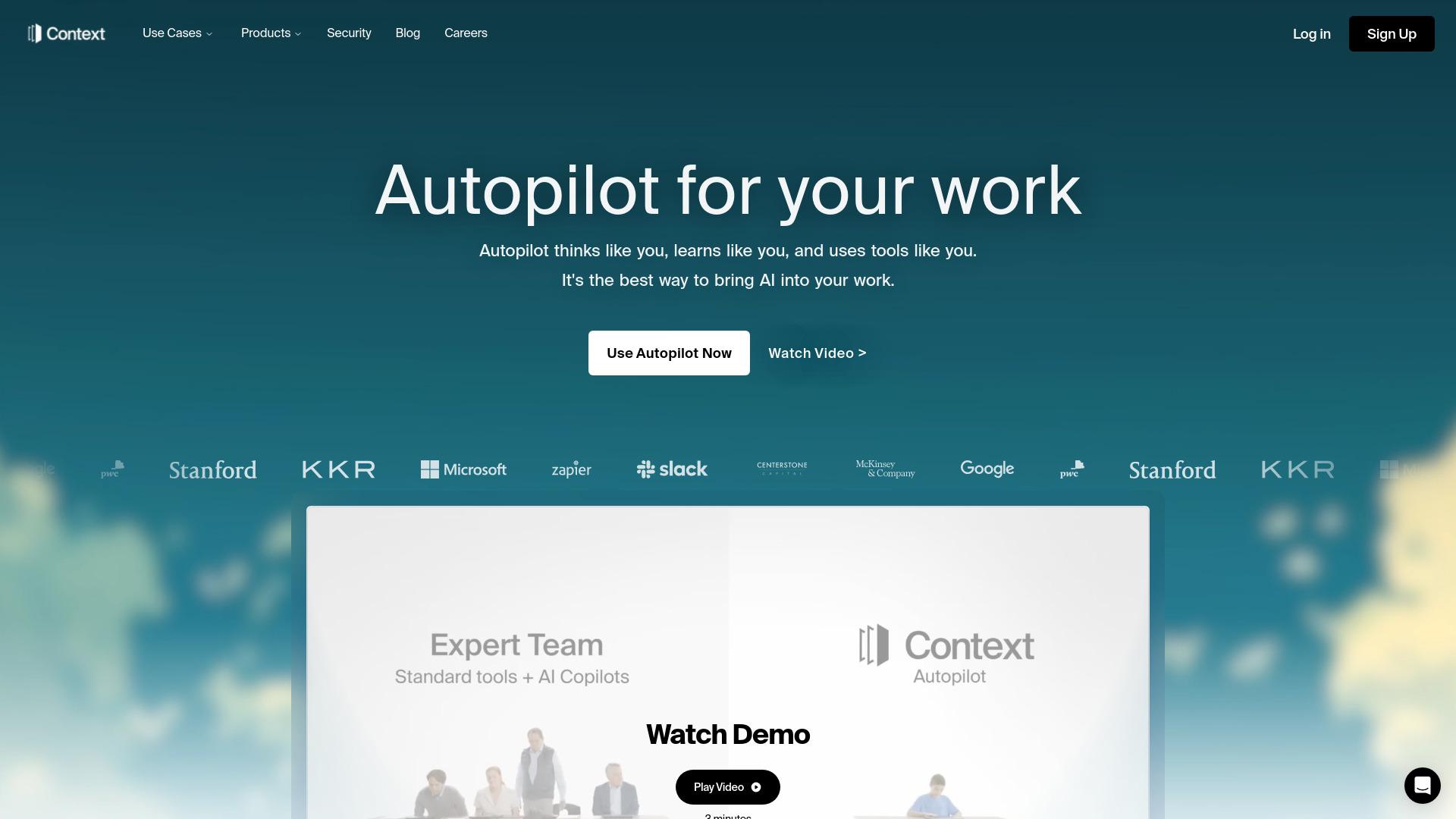
Context enhances marketing strategies by enabling data-informed, personalized content creation. It delivers valuable audience insights, allowing businesses to optimize efforts, improve engagement, and drive conversions. With tailored messaging and effective storytelling, Context helps marketers connect with their audience on a deeper level, ensuring content resonates and...
Context enhances marketing strategies by enabling data-informed, personalized content creation. It delivers valuable audience insights, allowing businesses to optimize efforts, improve engagement, and drive conversions. With tailored messaging and effective storytelling, Context helps marketers connect with their audience on a deeper level, ensuring content resonates and motivates action. By leveraging data to shape content, Context empowers brands to create more impactful marketing campaigns and achieve better results.
Integrates seamlessly with tools like Slack, Google Drive, and SharePoint.
Utilizes a context engine for deep understanding and task execution.
Supports complex, multi-step workflows across various applications.
Provides AI-generated insights and summaries from extensive data sources.
Offers real-time collaboration with version control and commenting features.
Includes Autopilot assistant for content creation and campaign planning.
Ensures data privacy with enterprise-grade security measures.
Adapts to user preferences, learning from interactions to improve over time.
You Got Questions,We Got Answers
What is Contextual Targeting?
Contextual Targeting is a marketing strategy that delivers targeted ads based on the content of a webpage. It analyzes the content and context to match relevant advertisements, enhancing user engagement and ad relevance.
How does Contextual Targeting work?
Contextual Targeting uses algorithms to scan webpage content in real-time. It identifies keywords, topics, and themes to serve advertisements that align with the user's current interests and the content.
Is Contextual Targeting effective?
Contextual Targeting is effective in reaching targeted audiences by ensuring ads appear in relevant contexts, increasing the likelihood of user interaction and conversion.
Can I customize my ads with Contextual Targeting?
Contextual Targeting allows you to customize ads by setting specific parameters and targeting criteria to align advertisements with your brand message and goals.
How does Contextual Targeting ensure privacy?
Contextual Targeting respects user privacy by not relying on personal data for ad targeting, focusing instead on the content of the webpage and minimizing the collection of personally identifiable information.
Is there a cost associated with Contextual Targeting?
Contextual Targeting has costs based on ad placements, impressions, or clicks, depending on the advertising strategy chosen.
How can I measure the success of Contextual Targeting?
Contextual Targeting success can be measured through metrics like click-through rates (CTR), conversion rates, and engagement, providing insights into ad performance and user interaction.
Can Contextual Targeting be combined with other marketing strategies?
Contextual Targeting can be combined with strategies like behavioral targeting and retargeting to enhance campaign effectiveness and reach.
Use cases
Marketing
Context enables marketers to swiftly produce high-quality content such as ad headlines, social media posts, and product descriptions, all tailored to the brand's voice. This accelerates campaign deployment and ensures consistent messaging.
Traffic and Engagement
Jan 2026 - Mar 2026
World wide
Monthly visitors (March)
7.6k
Page/Visit
2.79
Visit Duration
0s
Bounce Rate
0.4
Pricing
Free
$0
Context Embeds
Copied!
Let your community know you're live on Skillcurb! Just drop a badge on your site’s homepage with just a few clicks. Showcasing the badge helps increase your visibility and connects you with users actively exploring top AI tools.