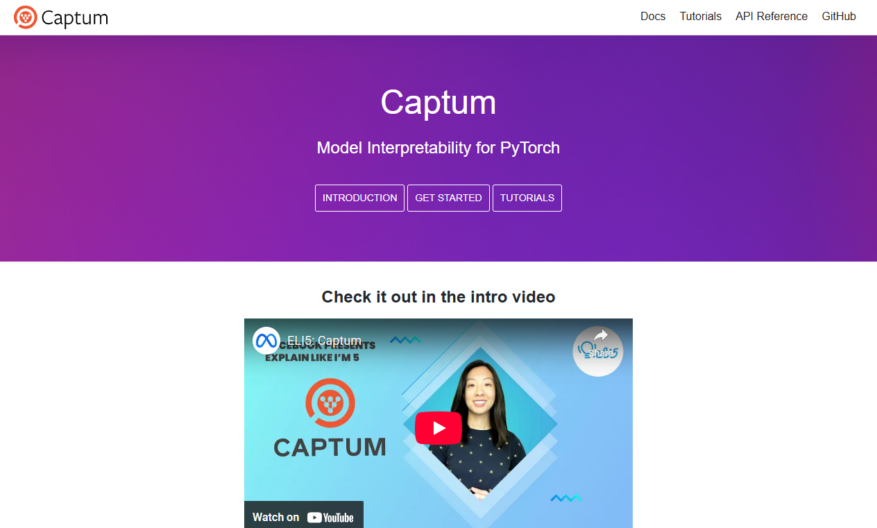
Captum is an innovative library designed for model interpretability in PyTorch, developed by Facebook Inc. This powerful tool enables users to gain insights into their machine learning models by providing a suite of interpretability algorithms that help identify the influence of input features on predictions. To...
Captum is an innovative library designed for model interpretability in PyTorch, developed by Facebook Inc. This powerful tool enables users to gain insights into their machine learning models by providing a suite of interpretability algorithms that help identify the influence of input features on predictions. To get started with Captum, users simply need to install the library, prepare their model, and define the input and baseline tensors. Captum is highly extensible and supports multi-modal data, making it versatile for various applications. Its primary use case is interpretability research, allowing researchers and practitioners to understand and trust their models better. With Captum, users can enhance their model analysis and visualize how different input features contribute to the decision-making process. The official Captum GitHub repository serves as a comprehensive resource for installation guides and examples. Overall, Captum empowers users to unlock the intricate workings of their models, fostering transparency in AI.
Model interpretability through attribution methods for neural networks and other models.
Visualization of attribution results for better understanding of model behavior.
Support for a wide range of deep learning frameworks and models.
Integration with popular frameworks such as PyTorch and TensorFlow.
Extensive library of attribution algorithms and techniques.
Implementation of various visualization methods for attribution results.
You Got Questions,We Got Answers
What is Captum?
Captum is an open-source Python library for model interpretability, providing state-of-the-art tools for understanding and explaining machine learning models, enabling users to build more transparent, and trustworthy AI systems.
How does Captum work?
Captum works by providing a suite of algorithms and techniques for model interpretability, allowing users to analyze and visualize the relationships between input features and model predictions, enabling a deeper understanding of model behavior.
What models does Captum support?
Captum supports a wide range of machine learning models, including PyTorch, TensorFlow, and scikit-learn models, allowing users to apply interpretability techniques to their existing models and workflows.
Is Captum easy to use?
Yes, Captum is designed to be easy to use, with a simple and intuitive API, allowing users to quickly and easily integrate interpretability techniques into their existing workflows and models.
Can I use Captum for production?
Yes, Captum is suitable for production use, providing scalable and efficient interpretability techniques that can be integrated into production workflows, enabling users to build more transparent and trustworthy AI systems.
Is Captum open-source?
Yes, Captum is open-source, allowing users to contribute to the development and growth of the library, and ensuring that the community can help shape the future of model interpretability.
Use cases
Healthcare
A hospital uses Captum to analyze its deep learning-based diagnosis system, identifying biases in the algorithm that lead to misdiagnosis of certain patient demographics, and improving overall accuracy and fairness of the system
Finance
A investment firm leverages Captum to explain the decisions made by its AI-powered trading platform, ensuring compliance with regulatory requirements and reducing the risk of unexpected losses due to model opacity
Retail
An e-commerce company utilizes Captum to interpret the product recommendations generated by its neural network, optimizing the suggestions to increase customer engagement and drive sales revenue
Manufacturing
A manufacturing plant employs Captum to analyze the predictive maintenance model used to detect potential equipment failures, identifying the most critical factors contributing to the predictions and reducing downtime and repair costs
Marketing
A marketing agency uses Captum to explain the targeting of its online advertisements, ensuring that the ads are delivered to the intended audience and increasing the effectiveness of the campaigns
Education
A university deploys Captum to analyze the performance of its AI-based grading system, identifying biases in the grading process and improving the fairness and accuracy of the assessment results
Traffic and Engagement
Mar 2026 - May 2026
World wide
Monthly visitors (May)
19.2k
Page/Visit
2.1
Visit Duration
52s
Bounce Rate
0.5%
Pricing
Free
$0.00
Captum Embeds
Copied!
Let your community know you're live on Skillcurb! Just drop a badge on your site’s homepage with just a few clicks. Showcasing the badge helps increase your visibility and connects you with users actively exploring top AI tools.