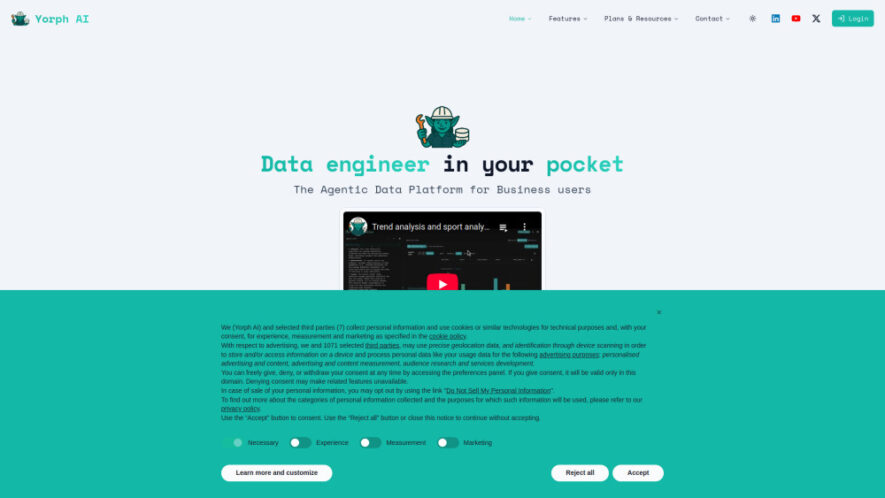
Yorph AI is an agentic data platform that helps business teams prepare, transform, analyze, and visualize data without relying on technical data engineers. Users can connect sources, clean datasets, create transformations, explore insights, and build recurring workflows through natural language. Dry runs, clarifying questions, semantic awareness,...
Yorph AI is an agentic data platform that helps business teams prepare, transform, analyze, and visualize data without relying on technical data engineers. Users can connect sources, clean datasets, create transformations, explore insights, and build recurring workflows through natural language. Dry runs, clarifying questions, semantic awareness, version control, and privacy controls help teams validate logic before production. It supports recurring reports, exploratory analysis, cross-source data joining, data cleaning, and semantic layer creation.
Natural Language Data Workflows Clean, transform, analyze, and visualize data using simple natural language.
Data Source Integration Connect and synchronize data from multiple sources through available connectors.
Semantic Awareness Continuously improve data understanding through evolving semantic context and interactions.
Custom Transformations Create customizable, reliable, and version-controlled data transformation workflows easily.
Dry Run Validation Test workflows and validate logic before executing changes in production.
Saved Prompts Save frequently used prompts for faster, repeatable data workflows.
Smart Recommendations Get intelligent recommendations for cleaning, analyzing, and improving business data.
Security Controls Protect sensitive business information with strict security and privacy controls.
You Got Questions,We Got Answers
1. What is Yorph AI designed to help teams do?
Yorph AI helps business users prepare, transform, analyze, and visualize data through natural language workflows, reducing the need for advanced technical data engineering skills and supporting faster everyday business decisions.
2. How can users connect business data with Yorph AI?
Users can upload datasets or connect available data sources through supported connectors, allowing teams to synchronize information and begin working with their business data efficiently, securely, and collaboratively together across workflows.
3. Can Yorph AI clean and transform data automatically?
Yes. Users can ask the agent to clean, transform, join, and analyze datasets while receiving recommendations that improve data quality, accuracy, and workflow efficiency across common business tasks and reporting needs.
4. What makes Yorph AI different from traditional data tools?
Yorph AI combines natural language interaction, semantic awareness, dry-run validation, customizable transformations, and data connectors to simplify complex data preparation for business teams without extensive technical expertise or specialized engineering support.
5. Does Yorph AI support recurring business reporting workflows?
Yes. Teams can create repeatable workflows for daily or weekly reporting, helping automate recurring data preparation, analysis, and reporting tasks while improving consistency, efficiency, and operational visibility across business teams.
6. How does Yorph AI help validate data transformation logic?
Yorph AI uses dry runs and clarifying questions to help users review, test, and validate transformation logic before applying workflows to production data, reducing avoidable errors and unexpected workflow results.
7. Can users control how data is stored and protected?
Yes. Yorph AI provides privacy settings, including an option not to store data, alongside strict security controls designed to protect business information and user preferences throughout data preparation workflows and activities.
8. Who can benefit most from using Yorph AI?
Product managers, analysts, operations teams, and business domain experts can use Yorph AI to manage data preparation, analysis, visualization, and recurring workflows more independently across different business needs and projects.
Use cases
Reporting
Automate daily or weekly reporting workflows by preparing, transforming, analyzing, and organizing business data consistently.
Exploration
Explore cohorts, lifetime value, trends, and other one-off analyses using conversational data workflows.
Joining
Combine information from multiple sources to create richer datasets for analysis and business decision-making.
Cleaning
Identify and clean inconsistent, incomplete, or messy datasets through simple natural language instructions and recommendations.
Semantics
Build a semantic layer that continuously improves data understanding as users interact with the platform.
Visualization
Turn prepared datasets into clear visualizations that help teams understand patterns, trends, and important business insights.
Automation
Create repeatable transformation workflows that reduce manual data preparation and support consistent operational processes.
Validation
Test transformation logic through dry runs and clarifying questions before executing workflows against production data.
Pricing
Free
$0
Yorph AI Embeds
Copied!
Let your community know you're live on Skillcurb! Just drop a badge on your site’s homepage with just a few clicks. Showcasing the badge helps increase your visibility and connects you with users actively exploring top AI tools.