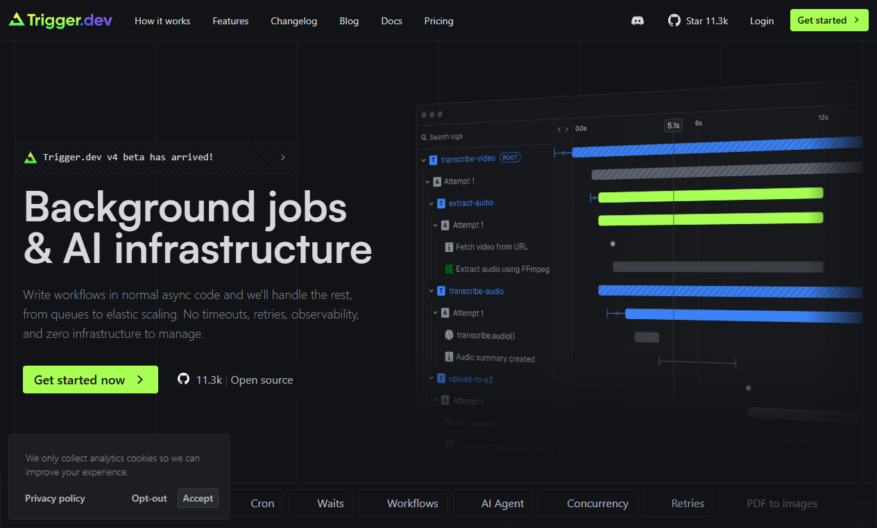
Trigger.dev is a cloud-based automation platform that enables users to automate repetitive tasks and workflows across multiple applications and systems. It provides a visual interface for building workflows, with a library of pre-built triggers and actions for popular services like GitHub, Trello, and Google Drive. Users...
Trigger.dev is a cloud-based automation platform that enables users to automate repetitive tasks and workflows across multiple applications and systems. It provides a visual interface for building workflows, with a library of pre-built triggers and actions for popular services like GitHub, Trello, and Google Drive. Users can create custom integrations using webhooks, APIs, and SDKs, and trigger.dev handles the underlying infrastructure and scalability. The platform offers real-time monitoring, error handling, and collaboration features, making it suitable for various use cases, from simple workflows to complex enterprise integrations.
Automate workflows with custom triggers and conditional logic.
Execute tasks with precision and accuracy.
Streamline processes with real-time data synchronization.
Leverage machine learning models for predictive analytics.
Integrate with popular services via APIs and webhooks.
Monitor and analyze performance with customizable dashboards and visualizations.
Ensure data security and compliance with enterprise-grade infrastructure.
Scale workflows efficiently with distributed task processing.
You Got Questions,We Got Answers
What is Trigger.dev?
Trigger.dev is a cloud-based automation platform that enables developers to automate repetitive tasks and processes, increasing productivity and efficiency.
How does it work?
Trigger.dev works by connecting to various APIs and services, allowing users to create custom workflows and automations that can be triggered by specific events or schedules.
What can I automate?
You can automate a wide range of tasks and processes, including code reviews, deployments, testing, and more, using Trigger.dev's intuitive interface and customizable workflows.
Is it secure?
Yes, Trigger.dev takes security seriously, with enterprise-grade security features, including encryption, access controls, and auditing, to ensure your automations are secure and reliable.
How does Trigger.dev work?
Trigger.dev allows you to define tasks in your codebase using its SDK. These tasks can be triggered from your backend or frontend applications. The platform handles the execution of these tasks in a scalable and reliable manner, providing features like queuing, retries, and observability.
Does Trigger.dev support scheduled tasks?
Yes, Trigger.dev supports scheduled tasks using cron expressions. You can define tasks to run at specific intervals or times, enabling you to automate recurring workflows.
Use cases
Healthcare
Automate patient data integration with electronic health records, enabling real-time updates and reducing manual errors, while ensuring HIPAA compliance and improving patient care
Finance
Streamline payment processing by automating transaction reconciliations, reducing errors, and ensuring compliance with regulatory requirements, such as PCI-DSS and AML/KYC
Retail
Optimize inventory management by automating stock replenishment, reducing stock and understock scenarios, and ensuring timely restocking, resulting in improved customer satisfaction and reduced costs
Manufacturing
Implement automated quality control checks, ensuring compliance with industry regulations, and reducing production downtime by identifying defects early, resulting in increased productivity and improved product quality
Marketing
Automate customer segmentation, enabling targeted campaigns, and improving customer engagement, resulting in increased conversions and revenue growth
Education
Automate student data integration, enabling personalized learning experiences, and improving student outcomes, resulting in increased student retention and overall academic success
Traffic and Engagement
Feb 2026 - Apr 2026
World wide
Monthly visitors (April)
167.1k
Page/Visit
9.5
Visit Duration
5m 50s
Bounce Rate
0.4%
Pricing
Free
$0
Trigger.dev Embeds
Copied!
Let your community know you're live on Skillcurb! Just drop a badge on your site’s homepage with just a few clicks. Showcasing the badge helps increase your visibility and connects you with users actively exploring top AI tools.