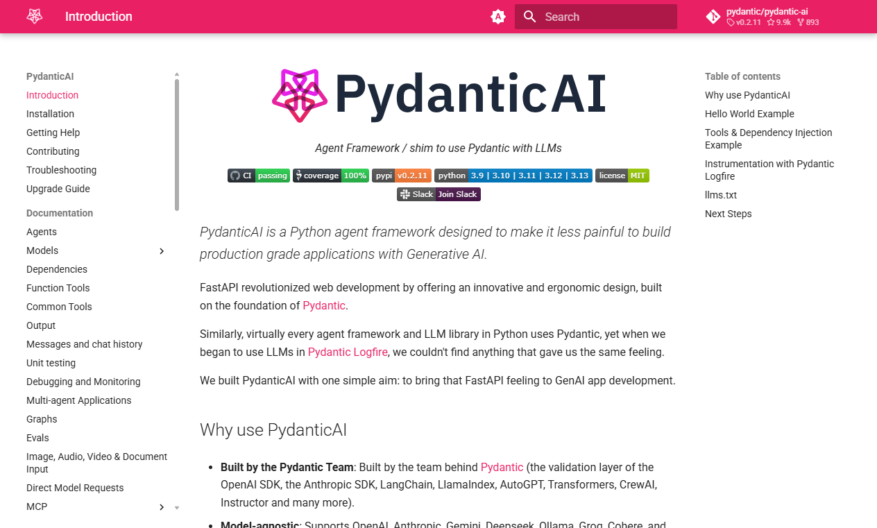
PydanticAI PydanticAI allows you to build AI applications with type-safe interfaces, integrating with multiple LLM providers. It validates model outputs using Pydantic schemas, ensuring reliability. Dependency injection is used for modular design, and applications are monitored with Pydantic Logfire integration. The platform supports structured responses from...
PydanticAI PydanticAI allows you to build AI applications with type-safe interfaces, integrating with multiple LLM providers. It validates model outputs using Pydantic schemas, ensuring reliability. Dependency injection is used for modular design, and applications are monitored with Pydantic Logfire integration. The platform supports structured responses from AI models and facilitates unit testing of components. Workflows can be customized with flexible configurations for enhanced adaptability.
Automatic data validation and parsing with robust error handling mechanisms.
Support for advanced data modeling with Python type hints and annotations.
Generation of high-quality JSON Schemas for data exchange and documentation.
Built-in support for popular data formats like JSON, CSV, and TOML.
Powerful data transformation and mapping capabilities using Python logic.
Robust data validation with support for recursive and nested data structures.
Seamless integration with popular Python frameworks and libraries like FastAPI.
Advanced features for data modeling, and error handling with custom plugins.
You Got Questions,We Got Answers
What is Pydantic AI?
Pydantic AI is an AI-powered tool that helps developers create high-quality, production-ready Python applications quickly and efficiently, leveraging the power of Pydantic and its ecosystem.
Is Pydantic AI free?
Pydantic AI is free to use for open-source projects and small-scale commercial projects, but it offers premium features and support for larger-scale commercial projects, requiring a subscription or a one-time payment.
How does Pydantic AI?
Pydantic AI uses a combination of natural language processing, machine learning algorithms to analyze project requirements and generate high-quality Python applications, leveraging the power of Pydantic and its ecosystem.
What are Agents in Pydantic AI?
In Pydantic AI, Agents are the primary interface for interacting with LLMs. An Agent encapsulates the system prompt, tools (functions the LLM can call), structured output types, and dependencies. Agents can be configured to handle specific tasks, and multiple agents can be composed to manage complex workflows.
What is the Model Context Protocol (MCP)?
The Model Context Protocol (MCP) is a standardized protocol supported by Pydantic AI that allows AI applications to connect to external tools and services using a common interface. Pydantic AI can act as both an MCP client and server, enabling seamless integration with other MCP-compliant tools and services.
What are Function Tools in Pydantic AI?
Function Tools in Pydantic AI provide a mechanism for models to retrieve additional information to aid in generating responses. They can be registered with an Agent and are useful when it's impractical to include all necessary context in the system prompt. Function Tools can be registered via decorators or passed directly to the Agent.
Use cases
Healthcare
A medical research institution uses Pydantic to validate and standardize clinical trial data, ensuring consistency and accuracy in results
Finance
A financial services company leverages Pydantic to create robust APIs for secure transaction processing and data exchange
Manufacturing
A global manufacturer employs Pydantic to streamline production workflows by validating and standardizing equipment sensor data
Retail
An e-commerce platform utilizes Pydantic to validate and process customer order data, reducing errors and improving order fulfillment rates
Marketing
A marketing automation platform relies on Pydantic to validate and standardize customer data, ensuring personalized campaigns and improved customer engagement
Education
A learning management system uses Pydantic to validate and standardize student data, ensuring accurate tracking of student progress and improved educational outcomes
Traffic and Engagement
Feb 2026 - Apr 2026
World wide
Monthly visitors (April)
243.9k
Page/Visit
8.8
Visit Duration
7m 10s
Bounce Rate
0.3%
Pricing
Free
$0
PydanticAI Embeds
Copied!
Let your community know you're live on Skillcurb! Just drop a badge on your site’s homepage with just a few clicks. Showcasing the badge helps increase your visibility and connects you with users actively exploring top AI tools.