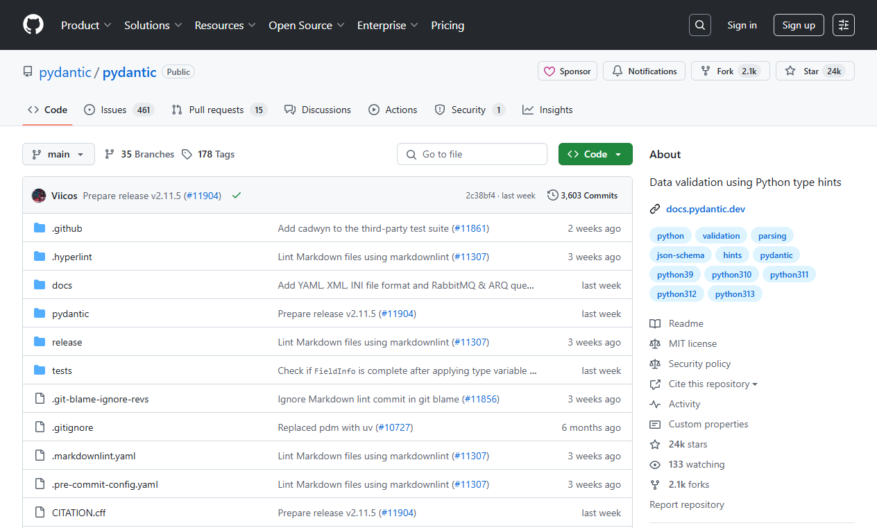
Pydantic is a Python library that provides a robust and flexible way to define and validate data structures, including JSON and ORM models, using Python type hints, with a focus on performance, readability and ease of use, featuring robust validation, error handling, and support for advanced...
Pydantic is a Python library that provides a robust and flexible way to define and validate data structures, including JSON and ORM models, using Python type hints, with a focus on performance, readability and ease of use, featuring robust validation, error handling, and support for advanced use cases, such as nested models, custom validation, and serialization and deserialization, making it a popular choice for building robust and maintainable data models and APIs.
Support for Python type hints and 3.5+ syntax including async and await.
Automatic generation of validators for user-defined types.
Robust support for nested and recursive data structures.
Built-in support for parsing and validation of JSON, CSV, and TOML data.
Extensive support for custom validation logic via decorators and callbacks.
Automatic conversion of data to and from Python dictionaries.
Support for advanced data modeling concepts like unions and discriminated unions.
Extensive documentation and a growing community of contributors and users.
You Got Questions,We Got Answers
What is Pydantic?
Pydantic is a Python library that allows you to create objects from dictionaries and other data sources, with validation and error handling, making it ideal for data serialization and deserialization.
Is Pydantic fast?
Yes, Pydantic is highly optimized for performance, using advanced techniques like caching and lazy parsing, making it suitable for large-scale applications.
What is data validation?
Data validation is the process of checking if data meets certain criteria or rules, and Pydantic provides a robust and flexible way to perform data validation, allowing you to define custom validation rules.
Can I use Pydantic with APIs?
Absolutely, Pydantic is well-suited for building robust APIs, as it provides a clear and consistent way to define and validate API data models, making it easier to build and maintain APIs.
Is Pydantic compatible with Python 3?
Yes, Pydantic is fully compatible with Python 3.7, 3.8, 3.9, and later versions, and it is also compatible with Python 3.6, but with some limitations.
How do I install Pydantic?
You can install Pydantic using pip, the Python package manager, by running the command pip install pydantic, and it will be installed and ready to use in your Python project.
Use cases
Healthcare
A medical research institution uses Pydantic to validate and serialize complex patient data, ensuring accuracy and consistency across different systems and studies
Finance
A fintech company leverages Pydantic to define and enforce strict data models for trading and risk analysis, reducing errors and ensuring compliance
Retail
An e-commerce platform utilizes Pydantic to validate and normalize product data from various suppliers, ensuring data quality and consistency across the online catalog
Manufacturing
A manufacturing firm employs Pydantic to define and validate complex product configurations, ensuring that custom orders meet precise specifications and quality control standards
Marketing
A marketing analytics firm uses Pydantic to define and enforce data models for customer behavior and preference data, enabling accurate targeting and personalization
Education
A learning management system employs Pydantic to validate and serialize complex educational data, ensuring data integrity and consistency for personalized learning pathways
Traffic and Engagement
Feb 2026 - Apr 2026
World wide
Monthly visitors (April)
492.1m
Page/Visit
6.2
Visit Duration
6m 33s
Bounce Rate
0.4%
Pricing
Free
$0
Pydantic Embeds
Copied!
Let your community know you're live on Skillcurb! Just drop a badge on your site’s homepage with just a few clicks. Showcasing the badge helps increase your visibility and connects you with users actively exploring top AI tools.