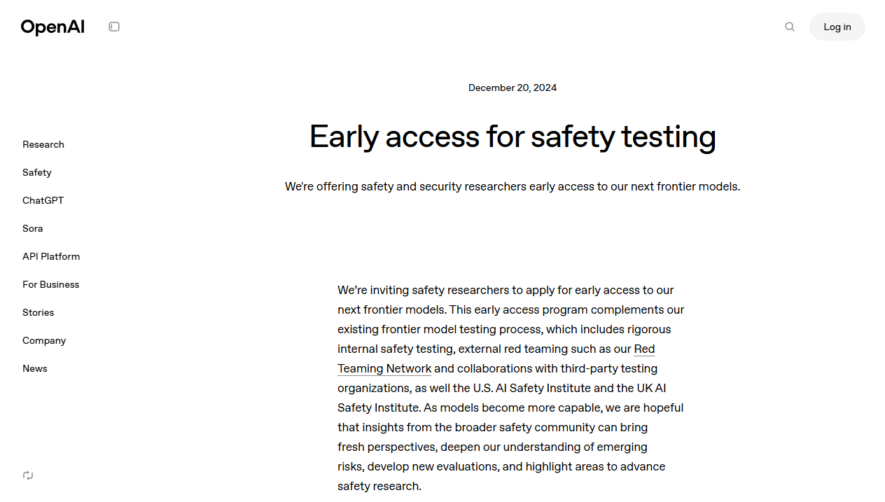
OpenAI's Early Access for Safety Testing, a program allowing select organizations to test AI systems for safety and robustness before deployment, ensuring responsible AI development and minimizing potential risks, providing a safe and controlled environment for testing, and facilitating collaboration and knowledge sharing among participants, ultimately...
OpenAI's Early Access for Safety Testing, a program allowing select organizations to test AI systems for safety and robustness before deployment, ensuring responsible AI development and minimizing potential risks, providing a safe and controlled environment for testing, and facilitating collaboration and knowledge sharing among participants, ultimately contributing to the development of AI systems that benefit society as a whole.
Early access to AI models for safety testing and evaluation purposes.
Customizable testing environments for tailored safety assessments and experiments.
Real-time feedback and analytics for identifying and addressing safety concerns.
Collaborative tools for sharing results and best practices with the community.
Integration with popular development frameworks for seamless safety testing integration.
Priority support for addressing safety-critical issues and concerns.
You Got Questions,We Got Answers
What is early access for safety testing?
Early access for safety testing is a program that allows developers to test OpenAI's models in real-world environments, providing valuable feedback on safety and performance before public release. Who can apply for early access? Any developer or organization interested in testing OpenAI's models in real-world environments can apply for early access, including those in industries such as education, healthcare, and finance.
What kind of testing is involved?
Testing involves integrating OpenAI's models in real-world applications, identifying potential safety issues, and providing detailed feedback to OpenAI to improve model performance and safety.
How does the application process work?
The application process involves submitting a proposal detailing the testing environment, use cases, and expected outcomes, which will be reviewed by OpenAI's team to ensure alignment with safety testing goals.
What kind of support is provided?
OpenAI provides technical support, including access to documentation, testing tools, and dedicated support channels, as well as regular check-ins to discuss progress, challenges, and feedback.
What are the benefits of early access?
Early access provides developers with early insights into OpenAI's models, allowing them to develop safer and more effective applications, while contributing to the development of more responsible AI solutions.
Use cases
Healthcare
AI-powered chatbots can help identify high-risk patients, allowing for early interventions, and reducing hospital readmission rates, while also assisting with clinical trial participant recruitment and retention
Finance
AI-driven risk assessment tools can detect and prevent fraudulent transactions, reducing financial losses and improving overall security
Retail
AI-based product recommendation systems can increase average order value, enhance customer satisfaction, and reduce cart abandonment rates
Manufacturing
AI-powered predictive maintenance can reduce equipment downtime, increase production efficiency, and lower maintenance costs
Marketing
AI-driven social media monitoring can help identify brand reputation threats, enabling swift crisis management and preserving brand integrity
Education
AI-powered learning systems can provide personalized educational content, improving student engagement, and enhancing overall academic performance
Traffic and Engagement
Dec 2026 - Feb 2026
World wide
Monthly visitors (February)
505m
Page/Visit
2.2
Visit Duration
1m 47s
Bounce Rate
0.6
Pricing
Free
$0
OpenAI o3 Embeds
Copied!
Let your community know you're live on Skillcurb! Just drop a badge on your site’s homepage with just a few clicks. Showcasing the badge helps increase your visibility and connects you with users actively exploring top AI tools.