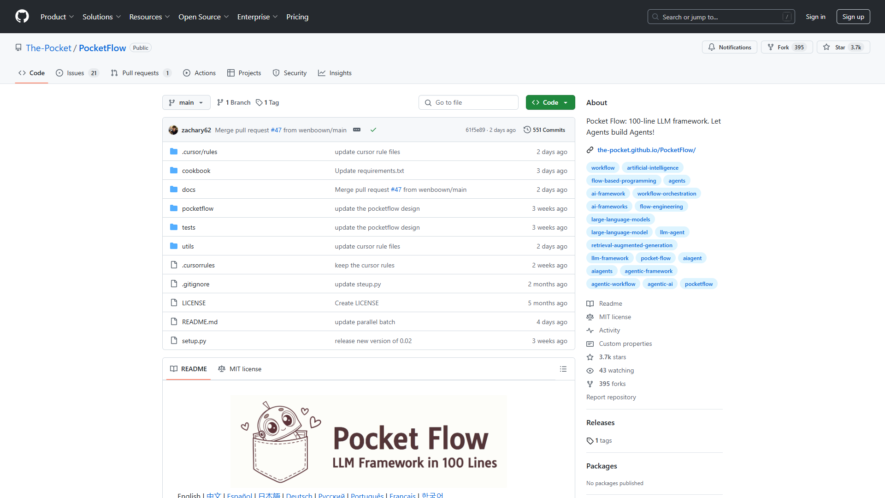
miniLLMFlow is a lightweight and efficient open-source framework for building and serving large language models. It provides a simple and unified interface for model management, inference, and deployment. miniLLMFlow supports for popular models like BERT, RoBERTa, and DistilBERT, and is designed for production environments, providing high...
miniLLMFlow is a lightweight and efficient open-source framework for building and serving large language models. It provides a simple and unified interface for model management, inference, and deployment. miniLLMFlow supports for popular models like BERT, RoBERTa, and DistilBERT, and is designed for production environments, providing high throughput and low memory usage. It also includes features like model ensembling, and automatic batching, making it an ideal choice for building and deploying AI-powered applications.
Supports multiple AI models for diversified task handling.
Offers real-time processing and instantaneous output generation.
Provides a user-friendly interface for effortless interaction.
Allows seamless integration with external applications and services.
Employs robust security measures to ensure data protection.
Supports continuous learning and model improvement mechanisms.
You Got Questions,We Got Answers
What is miniLLMFlow?
miniLLMFlow is an open-source, lightweight, and efficient large language model (LLM) inference framework that enables fast and scalable deployment of LLMs on various hardware platforms.
Is miniLLMFlow free?
miniLLMFlow is completely free and open-source, allowing developers to use and modify the code without any restrictions or costs, making it an ideal solution for academic and commercial use cases.
What is miniLLMFlow used for?
miniLLMFlow is designed for efficient inference of large language models, enabling applications such as language translation, text summarization, chatbots, and other natural language processing tasks.
Can I use miniLLMFlow for production?
Yes, miniLLMFlow is designed for production environments, providing high performance, scalability, and reliability, making it suitable for deploying large language models in real-world applications and services.
Is miniLLMFlow easy to use?
miniLLMFlow provides a simple and intuitive API, allowing developers to easily integrate and deploy large language models, even for those without extensive experience in deep learning or natural language processing.
What platforms are supported?
miniLLMFlow supports a wide range of platforms, including Windows, Linux, and cloud-based environments, allowing developers to deploy large language models on various hardware configurations and infrastructure.
Use cases
Healthcare
A hospital uses miniLLMFlow to analyze electronic health records and predict patient outcomes, enabling doctors to make more informed treatment decisions and improve patient care
Finance
A bank leverages miniLLMFlow to detect fraudulent transactions and identify high-risk customers, reducing financial losses and improving overall security
Retail
An e-commerce company utilizes miniLLMFlow to analyze customer purchase history and recommend personalized products, increasing sales and enhancing customer satisfaction
Manufacturing
A production facility uses miniLLMFlow to monitor equipment performance and predict maintenance needs, reducing downtime and improving overall efficiency
Marketing
A marketing agency employs miniLLMFlow to analyze customer sentiment and preferences, creating targeted campaigns that increase engagement and conversion rates
Education
A university uses miniLLMFlow to analyze student performance data and identify at-risk students, providing early intervention and improving academic outcomes
Traffic and Engagement
Jan 2026 - Mar 2026
World wide
Monthly visitors (March)
521.1m
Page/Visit
6.2
Visit Duration
6m 29s
Bounce Rate
0.4%
Pricing
Free
$0
Mini LLM Flow Embeds
Copied!
Let your community know you're live on Skillcurb! Just drop a badge on your site’s homepage with just a few clicks. Showcasing the badge helps increase your visibility and connects you with users actively exploring top AI tools.