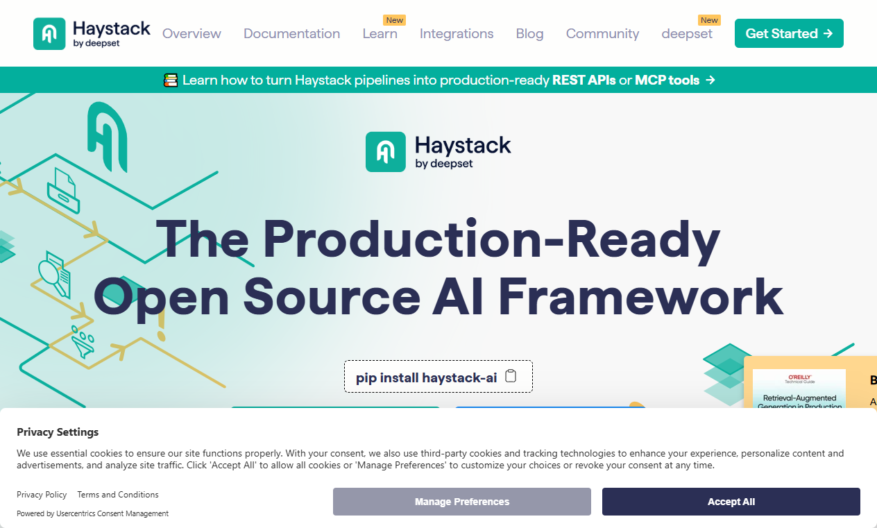
Haystack is an open-source framework that enables developers to build powerful and efficient question answering systems, allowing users to extract relevant information from large document collections. It provides a modular architecture, supporting various deep learning models, and offers features such as document indexing, question answering, and...
Haystack is an open-source framework that enables developers to build powerful and efficient question answering systems, allowing users to extract relevant information from large document collections. It provides a modular architecture, supporting various deep learning models, and offers features such as document indexing, question answering, and semantic search. Haystack is highly customizable, scalable, and integrates with popular libraries like Transformers and PyTorch, making it an ideal solution for a wide range of applications, and industries.
Supports various question-answering models for accurate results.
Offers a user-friendly interface for easy query construction.
Enables filtering of results based on document metadata.
Provides an intuitive result visualization for better understanding.
Allows for the creation of custom evaluation metrics.
Enables users to upload their own datasets for training.
Provides an extensive documentation for easy onboarding.
Offers a flexible deployment option for various environments.
You Got Questions,We Got Answers
What is Haystack?
Haystack is an open-source framework that enables developers to build powerful and efficient question answering systems at scale, supporting various data sources and formats.
What is the main goal?
The main goal of Haystack is to provide a flexible and modular architecture that enables developers to easily integrate and fine-tune their question answering models for specific use cases and domains.
What is the architecture?
The Haystack architecture consists of a Retriever, a Reader, and a Generator, which work together to retrieve relevant documents, extract answers, and generate responses to user queries.
How does Haystack work?
Haystack works by first retrieving relevant documents from a database or file system, then using a reader to extract answers from the retrieved text, and lastly ranking the answers to provide the most accurate response.
Can I use Haystack?
Yes, you can use Haystack for a wide range of applications, including customer support, chatbots, and knowledge management, and it supports various data sources such as text files, databases, and knowledge graphs.
What are the benefits?
The benefits of using Haystack include improved accuracy, reduced development time, and increased flexibility, as well as the ability to integrate with various data sources and formats.
Use cases
Healthcare
A hospital uses it to extract relevant information from medical records to identify high-risk patients and provide personalized treatment plans
Finance
A bank uses it to analyze customer feedback and sentiment to improve their services and detect potential fraud
Retail
An e-commerce company uses it to analyze product reviews and feedback to improve their product offerings and customer satisfaction
Manufacturing
A company uses it to analyze equipment sensor data to predict maintenance needs and reduce downtime
Marketing
A marketing agency uses it to analyze social media posts to identify trends and sentiment analysis
Education
A university uses it to analyze student feedback and sentiment to improve their courses and teaching methods
Traffic and Engagement
Feb 2026 - Apr 2026
World wide
Monthly visitors (April)
51.8k
Page/Visit
3.3
Visit Duration
4m 31s
Bounce Rate
0.6%
Pricing
Free
$0
Haystack Embeds
Copied!
Let your community know you're live on Skillcurb! Just drop a badge on your site’s homepage with just a few clicks. Showcasing the badge helps increase your visibility and connects you with users actively exploring top AI tools.