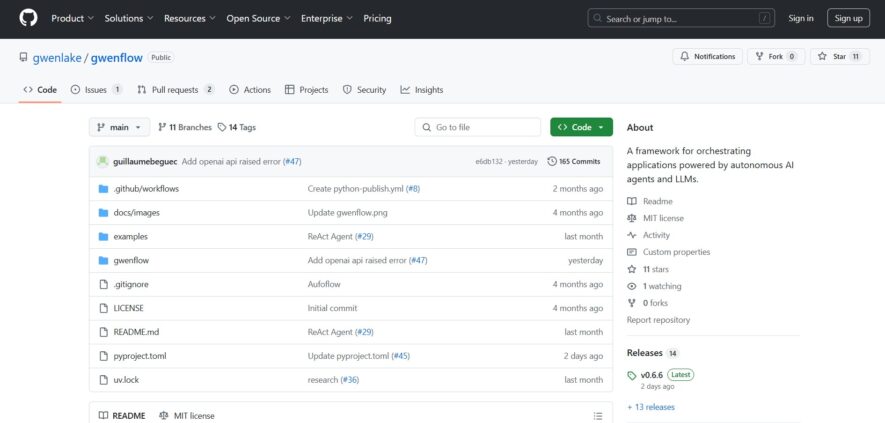
GwenFlow is an open-source workflow engine that enables users to model, automate, and monitor business processes. It provides a simple and intuitive interface to design workflows, define tasks, and assign responsibilities. GwenFlow supports various workflow patterns, including sequential, parallel, and conditional flows. It also integrates with...
GwenFlow is an open-source workflow engine that enables users to model, automate, and monitor business processes. It provides a simple and intuitive interface to design workflows, define tasks, and assign responsibilities. GwenFlow supports various workflow patterns, including sequential, parallel, and conditional flows. It also integrates with external systems and services through APIs and webhooks. The engine is highly customizable and scalable, making it suitable for a wide range of use cases.
Automated workflow management with visual flowcharts and conditional logic.
Decentralized workflow execution with Docker containerization and orchestration.
Real-time workflow monitoring and debugging with interactive visualizations.
Extensive library of pre-built workflow components and integrations.
Customizable workflow templates and user-defined components support.
Role-based access control and multi-tenancy support for enterprise use cases.
You Got Questions,We Got Answers
What is GwenFlow?
GwenFlow is a workflow engine written in Go, designed to be scalable, flexible, and easy to use, providing a simple yet powerful way to manage complex workflows.
What problems does it solve?
GwenFlow addresses common workflow engine issues, such as complexity, scalability, and performance, by providing a lightweight, modular, and highly customizable solution.
Is it scalable?
Yes, GwenFlow is designed to scale horizontally, allowing it to handle large volumes of workflows and tasks, making it suitable for large-scale enterprise applications.
Can I customize it?
Yes, GwenFlow provides a modular architecture, allowing developers to easily add custom tasks, workflows, and plugins, making it adaptable to specific business needs.
Is it open source?
Yes, GwenFlow is open-source, which means it's free to use, and distribute, and that the community contributes to its development and maintenance.
What's the learning curve?
GwenFlow has a gentle curve, thanks to its minimalistic design and clear documentation, making it easy for developers to get started and integrate it into their projects.
Use cases
Healthcare
Automating clinical workflows for medical imaging analysis, prioritizing high-risk patients, and ensuring timely diagnosis and treatment
Finance
Streamlining trade settlements, automating reconciliation, and reducing operational risks in high-volume transactions
Retail
Optimizing inventory management, automating order fulfillment, and improving supply chain visibility
Manufacturing
Automating quality control, monitoring production workflows, and detecting anomalies in real-time
Marketing
Orchestrating cross-channel campaigns, automating lead scoring, and personalizing engagement
Education
A university's computer science department aims to enhance student support in large introductory programming courses. Utilizing Gwenflow, the department develops an AI-powered virtual teaching assistant capable of answering student queries.
Traffic and Engagement
Feb 2026 - Apr 2026
World wide
Monthly visitors (April)
492.1m
Page/Visit
6.2
Visit Duration
6m 33s
Bounce Rate
0.4%
Pricing
Free
$0
Gwenflow Embeds
Copied!
Let your community know you're live on Skillcurb! Just drop a badge on your site’s homepage with just a few clicks. Showcasing the badge helps increase your visibility and connects you with users actively exploring top AI tools.