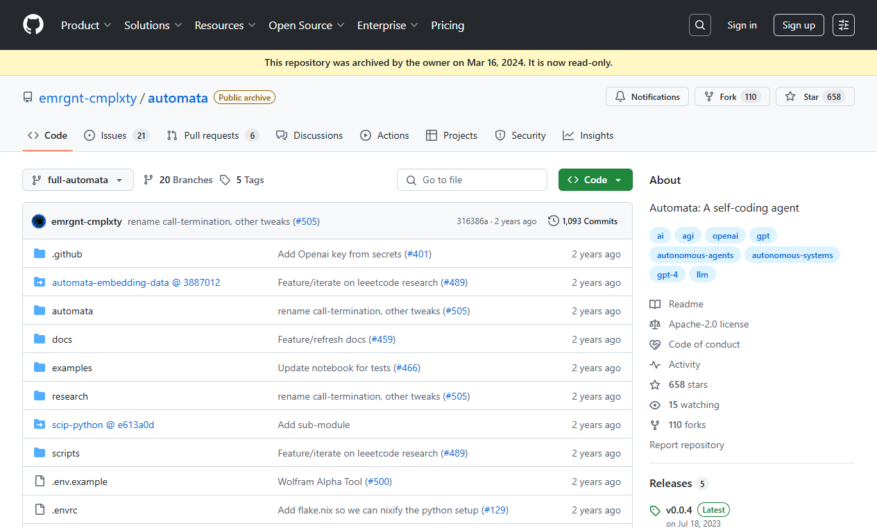
Automata is an open-source Python library for building, analyzing, and visualizing finite state machines and other types of automata, providing a simple and intuitive API for creating and manipulating automata, with features such as automaton minimization, determinization, and language recognition, as well as visualization tools for...
Automata is an open-source Python library for building, analyzing, and visualizing finite state machines and other types of automata, providing a simple and intuitive API for creating and manipulating automata, with features such as automaton minimization, determinization, and language recognition, as well as visualization tools for rendering automata as graphs, making it a valuable tool for researchers, students, and developers working with formal language theory and computational complexity.
Automata supports finite state machines with configurable transition rules and actions.
Automata allows definition of complex state machines with hierarchical structure.
Automata enables creation of probabilistic state machines with weighted transitions.
Automata provides support for Moore and Mealy machine architectures.
Automata allows for dynamic modification of machine structure at runtime.
Automata supports visualization of machine state transitions and execution paths.
Automata includes tools for testing and validating machine behavior.
Automata enables integration with external systems and event-driven architectures.
You Got Questions,We Got Answers
What is Automata used for?
Automata is a Python library used for building, manipulating, and exploring complex systems, enabling researchers to model and analyze intricate structures and dynamics in various domains, including biology, physics, and social sciences.
Can I use Automata library?
Yes, Automata is an open-source library, available under the MIT license, allowing users to freely use, modify, and distribute it for their research, academic, or personal projects, with no restrictions or fees.
How do I install Automata?
To install Automata, simply use pip, the Python package manager, by running the command pip install automata, ensuring you have Python 3.7 or later installed on your system, along with the required dependencies.
What is the Automata API?
The Automata API provides a set of functions and classes, enabling users to create, manipulate, and analyze complex systems, including tools for visualization, simulation, and data analysis, making it easy to work with complex systems and structures.
Can I contribute to Automata?
Yes, Automata is an open-source project, welcoming contributions, bug reports, and new features, allowing developers to participate in the development process, and shape the future of the library, and its applications.
Is Automata well-documented?
Yes, Automata comes with extensive documentation, including a user guide, API documentation, and examples, providing users with a comprehensive resource, helping them to get started, and make the most out of its features and capabilities.
Use cases
Healthcare
Automata helps analyze electronic health records to identify high-risk patients and predict disease progression, allowing for early interventions and improved patient outcomes
Finance
Automata's pattern recognition capabilities help identify fraudulent transactions and anomalies in financial data, reducing risk and improving compliance
Manufacturing
Automata's machine learning algorithms optimize production workflows, predicting equipment failures, and streamlining supply chain management, reducing costs and increasing productivity
Automata's adaptive learning systems analyze student performance data, providing real-time feedback and personalized instruction, enhancing student engagement and academic achievement
Marketing
By integrating Automata into their workflow, the marketing team accelerates the campaign development process, ensures consistency across channels, and gains valuable insights to refine their strategies.
Traffic and Engagement
Feb 2026 - Apr 2026
World wide
Monthly visitors (April)
492.1m
Page/Visit
6.2
Visit Duration
6m 33s
Bounce Rate
0.4%
Pricing
Free
$0
Automata Embeds
Copied!
Let your community know you're live on Skillcurb! Just drop a badge on your site’s homepage with just a few clicks. Showcasing the badge helps increase your visibility and connects you with users actively exploring top AI tools.