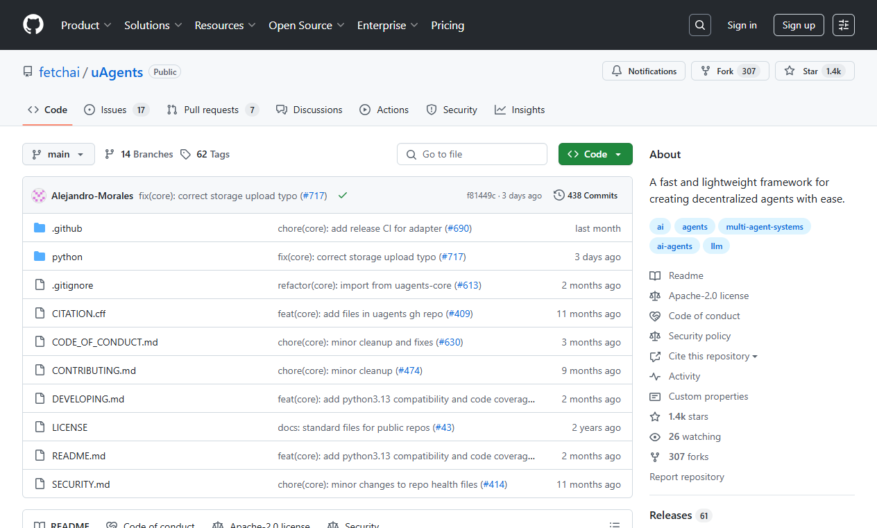
uAgents is an open-source framework for building autonomous agents that can interact with various systems and services, providing a unified interface for integrating different technologies and protocols, such as APIs, message queues, and IoT devices, enabling the creation of complex workflows and automation scenarios, and supporting...
uAgents is an open-source framework for building autonomous agents that can interact with various systems and services, providing a unified interface for integrating different technologies and protocols, such as APIs, message queues, and IoT devices, enabling the creation of complex workflows and automation scenarios, and supporting various programming languages, including Python, Java, and Node.js, with a focus on flexibility, scalability, and ease of use.
Autonomous agents interact with external environments through sensors and actuators.
Modular architecture enables easy integration of new components and algorithms.
Agents learn from experience using reinforcement learning and other methods.
Real-time data processing enables rapid response to changing situations.
Multi-agent systems enable complex behaviors and interactions.
Agents can be deployed on various platforms, including robots and IoT devices.
Advanced visualization tools facilitate understanding and debugging of agents.
Customizable frameworks support rapid development and prototyping.
You Got Questions,We Got Answers
What is uAgents and what is its purpose?
uAgents is an open-source framework that enables the creation of autonomous agents that can interact with various environments, providing a flexible and modular architecture for building complex AI systems.
What kind of environments can uAgents interact with?
uAgents can interact with various environments, including simulated, real-world, and hybrid environments, such as robotics, IoT, and virtual reality, allowing for a wide range of applications and use cases.
What is the architecture of uAgents?
The uAgents architecture is based on a modular design, comprising components such as perception, reasoning, and action modules, which can be easily customized and extended to accommodate different AI architectures and applications.
Can I use uAgents for commercial purposes?
Yes, uAgents is open-source and free to use, modify, and distribute, making it suitable for commercial applications, research, and development, with no licensing fees or restrictions.
How do I get started with uAgents?
To get started with uAgents, you can clone the repository, explore the documentation and examples, and join the community to get support and contribute to the development of the framework.
What programming languages are supported?
uAgents supports multiple programming languages, including Python, Java, and C++, allowing for flexibility and compatibility with various development environments and ecosystems.
Can I customize uAgents to my needs?
Yes, uAgents is highly customizable, allowing you to modify and extend the framework to accommodate specific requirements, environments, and AI architectures, making it suitable for a wide range of applications.
What kind of support is available?
The uAgents community provides support through documentation, tutorials, and community forums, where you can ask questions, report issues, and contribute to the development and maintenance of the framework.
Use cases
Healthcare
uAgents can help hospitals optimize resource allocation by simulating different staffing scenarios, predicting patient flow, and allocating resources accordingly, leading to improved patient care
Finance
uAgents can simulate trading scenarios, enabling financial institutions to test and optimize their trading strategies, reducing risk and improving returns
Retail
uAgents can simulate customer behavior, helping retailers optimize product placement, inventory management, and supply chain logistics, leading to increased sales and revenue
Manufacturing
uAgents can simulate production processes, enabling manufacturers to optimize production workflows, and reduce waste, leading to increased efficiency
Marketing
uAgents can simulate customer interactions, helping them optimize marketing campaigns, improve customer engagement, and reduce churn rates
Education
uAgents can simulate student learning behaviors, enabling them to optimize curriculum design, improve student outcomes, and reduce dropout rates
Traffic and Engagement
Feb 2026 - Apr 2026
World wide
Monthly visitors (April)
492.1m
Page/Visit
6.2
Visit Duration
6m 33s
Bounce Rate
0.4%
Pricing
Free
$0
uAgents Embeds
Copied!
Let your community know you're live on Skillcurb! Just drop a badge on your site’s homepage with just a few clicks. Showcasing the badge helps increase your visibility and connects you with users actively exploring top AI tools.