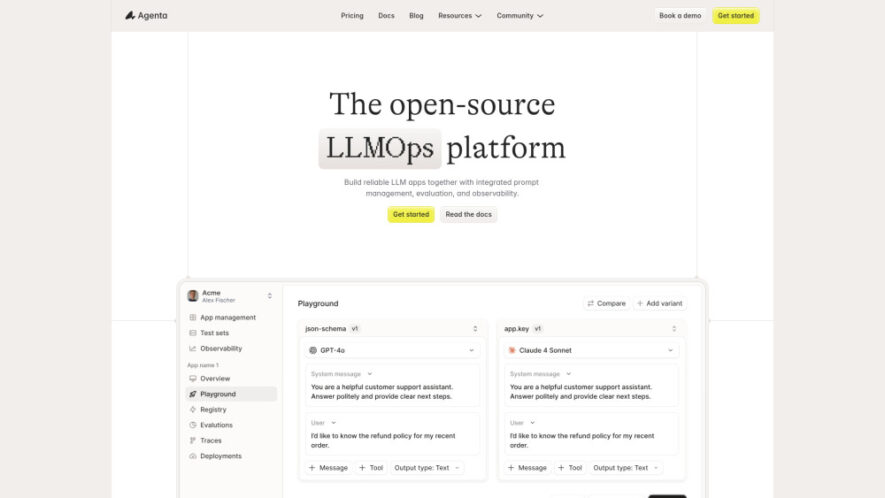
Agenta is an open-source LLMOps platform designed to help teams build, evaluate, debug, and monitor reliable LLM applications. It centralizes prompt management, engineering, experimentation, evaluation, observability, and collaboration within one structured workflow. Teams can compare prompts and models, track versions, evaluate outputs, trace requests, identify failures,...
Agenta is an open-source LLMOps platform designed to help teams build, evaluate, debug, and monitor reliable LLM applications. It centralizes prompt management, engineering, experimentation, evaluation, observability, and collaboration within one structured workflow. Teams can compare prompts and models, track versions, evaluate outputs, trace requests, identify failures, and monitor production performance. Agenta also enables technical and domain experts to collaborate efficiently throughout AI application development.
Prompt Management Centralize, organize, version, and improve prompts through a unified workspace.
Prompt Engineering Experiment with different prompts and optimize LLM application performance efficiently.
LLM Evaluation Evaluate AI outputs using automated and human evaluation methods consistently.
Model Comparison Compare different prompts and models side-by-side within unified experiments.
Observability Monitor production applications through detailed tracing, feedback, and performance insights.
Debugging Tools Trace requests and identify failure points across complex AI application workflows.
Team Collaboration Enable product managers and domain experts to participate directly in evaluations.
Open Source Use an open-source, model-agnostic platform supporting flexible AI development workflows.
You Got Questions,We Got Answers
1. What Is Agenta And What Does It Help Teams Do?
Agenta is an open-source LLMOps platform for building reliable AI applications. It provides tools for prompt management, engineering, evaluation, debugging, observability, and collaboration, helping teams organize development workflows and improve LLM applications with greater confidence.
2. How Does Agenta Support Prompt Management And Versioning?
Agenta centralizes prompts within a structured workspace, allowing teams to create, organize, experiment with, and version prompts. Developers can track changes through version history, compare iterations, and manage prompt development more systematically across projects.
3. Can Agenta Evaluate LLM Applications Automatically And Manually?
Yes. Agenta supports both automated and human evaluations for LLM applications. Teams can validate outputs, compare changes, gather feedback, and use evaluation results to determine whether prompts, models, or application updates improve overall performance.
4. How Does Agenta Help Debug Complex AI Applications?
Agenta provides tracing and debugging capabilities that allow teams to follow individual requests through complex LLM application workflows. Developers can inspect execution details, locate failure points, understand unexpected behavior, and investigate issues more efficiently.
5. Can Non-Technical Experts Collaborate Using Agenta?
Yes. Agenta enables product managers and domain experts to participate directly through its user interface. They can edit prompts, run evaluations, review results, and contribute domain knowledge without requiring extensive technical expertise or direct access to application code.
6. Does Agenta Provide Production Monitoring And Observability?
Agenta includes observability features for tracing, debugging, monitoring, and collecting feedback from production AI applications. These capabilities help teams understand application behavior, identify performance problems, and create feedback loops for continuous improvement after deployment.
7. Is Agenta Open Source And Model Agnostic?
Yes. Agenta is open source and designed to be model agnostic. This gives teams flexibility when building LLM applications, experimenting with different models, and integrating structured LLMOps practices without being restricted to a single model provider.
8. How Can Teams Compare Different Prompts And Models?
Teams can use Agenta's unified playground to run experiments and compare prompts or models side-by-side. This structured approach makes it easier to examine results, evaluate changes, track versions, and select configurations based on evidence and performance.
Use cases
LLM Development
Build and continuously improve reliable LLM applications through structured development workflows.
Evaluation
Systematically evaluate AI outputs and validate application changes using measurable evidence.
Debugging
Trace complex AI requests to discover errors and understand application failure points.
Prompting
Centralize prompt creation, experimentation, optimization, and version management across development teams.
Collaboration
Enable technical teams and domain experts to collaborate on AI application improvements.
Monitoring
Monitor production LLM applications and identify performance issues through detailed observability.
Experimentation
Run structured experiments to compare prompts, models, and application configurations efficiently.
Optimization
Improve AI application quality by combining evaluations, feedback, tracing, and iterative development.
Traffic and Engagement
Jun 2026 - Aug 2026
World wide
Monthly visitors (August)
29.1k
Page/Visit
2.04
Visit Duration
31s
Bounce Rate
40.22%
Pricing
Freemium
$49
Agenta Embeds
Copied!
Let your community know you're live on Skillcurb! Just drop a badge on your site’s homepage with just a few clicks. Showcasing the badge helps increase your visibility and connects you with users actively exploring top AI tools.