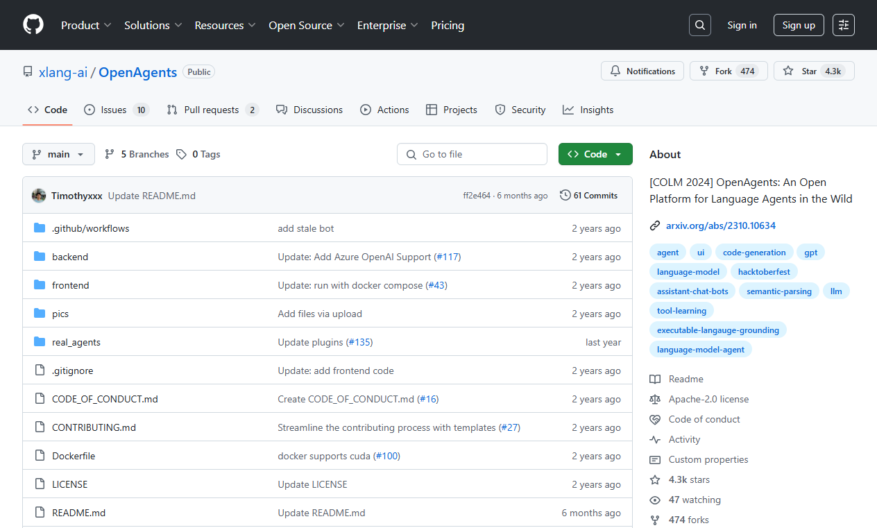
OpenAgents is an open-source framework for building and deploying AI-powered agents that can interact with humans and other systems. It provides a modular architecture for developing agents that can perform tasks such as conversational dialogue, natural language processing, and task automation. OpenAgents supports multiple AI engines...
OpenAgents is an open-source framework for building and deploying AI-powered agents that can interact with humans and other systems. It provides a modular architecture for developing agents that can perform tasks such as conversational dialogue, natural language processing, and task automation. OpenAgents supports multiple AI engines and can be integrated with various platforms and services. It's designed to be extensible and customizable, allowing developers to build and deploy agents that meet specific business needs.
Supports multiple agent types such as chatbots, drones, and robots.
Provides a unified API for controlling and interacting with agents.
Offers real-time data processing and analytics capabilities.
Supports integration with various data sources and AI models.
Provides a scalable and fault-tolerant architecture.
Allows for customization and extension of agents.
Supports multi-agent systems and coordination.
Provides a web-based interface for agent management.
You Got Questions,We Got Answers
What is OpenAgents?
OpenAgents is a framework for building multi-agent systems, allowing developers to create agents that can interact with each other and their environment, enabling complex behaviors and decision-making.
What is multi-agent system?
A multi-agent system is a computerized system composed of multiple autonomous entities, called agents, that interact with each other and their environment to achieve specific goals or tasks.
What is agent architecture?
An agent architecture is a high-level design that defines the components, interactions, and decision-making processes of an agent, including perception, reasoning, and action-taking capabilities.
What is agent?
A perception agent is a type of agent responsible for perceiving and processing sensory information from various sources, such as sensors, cameras, or other agents, to inform its decision-making.
What is decision-making agent?
A decision-making agent is a type of agent that uses reasoning and inference techniques to make decisions based on its goals, knowledge, and perceived environment.
What is OpenAgents written in?
OpenAgents is written in Python, a popular programming language, and utilizes various libraries and frameworks for building and deploying multi-agent systems.
What is the goal of OpenAgents?
The primary goal of OpenAgents is to provide a flexible and extensible framework for building and deploying multi-agent systems, enabling researchers and developers to explore and develop new AI applications.
What is the benefit of OpenAgents?
The main benefit of OpenAgents is that it enables rapid prototyping, testing, and iteration of multi-agent systems, reducing the development time and effort required to build complex AI applications.
Use cases
Healthcare
OpenAgents enables personalized medicine by integrating genomic data, medical histories, and real-time health metrics, allowing AI-driven agents to provide tailored treatment plans and risk assessments for patients
Retail
AI-powered agents analyze customer preferences, purchase histories, and social media interactions to offer targeted promotions, product recommendations, and personalized shopping experiences
Manufacturing
OpenAgents optimizes production workflows by integrating sensor data, and supply chain analytics, allowing AI agents to predict equipment failures, manage inventory, and streamline logistics
Finance
AI-driven agents analyze market trends, credit scores, and transaction histories to provide personalized investment advice, risk assessments, and fraud detection for investors and financial institutions
Marketing
OpenAgents enables data-driven marketing strategies, using AI agents to segment audiences, personalize content, and optimize campaign performance in real-time, maximizing ROI for advertisers
Let your community know you're live on Skillcurb! Just drop a badge on your site’s homepage with just a few clicks. Showcasing the badge helps increase your visibility and connects you with users actively exploring top AI tools.