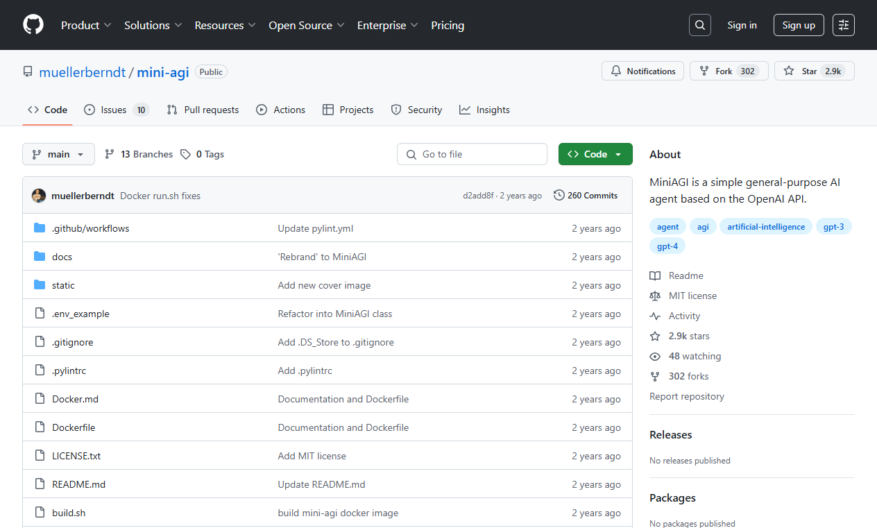
mini-agi is a minimalistic implementation of Artificial General Intelligence (AGI) in Python, aiming to demonstrate the feasibility of integrating various AI concepts into a single system. It includes modules for perception, reasoning, learning, and action, with a focus on simplicity and modularity. The project provides a...
mini-agi is a minimalistic implementation of Artificial General Intelligence (AGI) in Python, aiming to demonstrate the feasibility of integrating various AI concepts into a single system. It includes modules for perception, reasoning, learning, and action, with a focus on simplicity and modularity. The project provides a foundation for experimenting with and exploring the possibilities of AGI, and serves as an educational resource for understanding the principles and challenges of building a general-purpose intelligent system.
Supports multiple neural network architectures and transfer learning.
Provides an easy-to-use API for model training and inference.
Offers built-in support for popular deep learning frameworks.
Includes tools for data preprocessing and visualization.
Allows for customization of model hyperparameters and optimization.
Supports both CPU and GPU acceleration for faster training.
Provides features for model evaluation and performance metrics.
Includes examples and tutorials for real-world applications.
You Got Questions,We Got Answers
What is mini-agi?
Mini-agi is a lightweight artificial general intelligence (AGI) framework that enables developers to build and train AGI models with ease, focusing on cognitive architectures and cognitive computing.
What is cognitive architecture?
Cognitive architecture refers to a software framework that simulates human cognition process, mimicking how the human brain processes information, makes decisions, and learns from experiences.
How does mini-agi learn?
Mini-agi learns through a combination of reinforcement learning, unsupervised learning, and transfer learning, enabling the model to adapt to new situations and tasks with minimal human intervention.
What is cognitive computing?
Cognitive computing is a subfield of artificial intelligence that focuses on building machines that can think, reason, and learn like humans, mimicking human intelligence and cognitive abilities.
What is the goal of mini-agi?
The primary goal of mini-agi is to develop a general-purpose AGI model that can perform any intellectual task that a human can, achieving human-level intelligence and beyond.
Can I extend or customize MiniAGI?
Absolutely. MiniAGI is designed with modularity in mind, allowing developers to add new tools, memory mechanisms, or integrate vector databases for enhanced capabilities. There are discussions and suggestions in the issues section regarding such enhancements.
Use cases
Healthcare
A hospital uses mini-agi to analyze medical images and diagnose diseases more accurately, reducing the need for repeat scans and improving treatment outcomes
Finance
A bank uses mini-agi to detect and prevent fraudulent transactions in real-time, reducing financial losses and improving security
Retail
A retailer uses mini-agi supply chain optimization to reduce inventory costs and improve delivery times, increasing customer satisfaction and loyalty
Manufacturing
A manufacturer uses mini-agi to predict and prevent equipment failures, reducing downtime and increasing overall productivity
Marketing
An advertising agency uses mini-agi to analyze customer behavior and preferences, creating more targeted and personalized marketing campaigns
Education
An online learning platform uses mini-agi to create personalized learning paths for students, improving engagement and academic achievement
Traffic and Engagement
Feb 2026 - Apr 2026
World wide
Monthly visitors (April)
492.1m
Page/Visit
6.2
Visit Duration
6m 33s
Bounce Rate
0.4%
Pricing
Free
$0
Mini AGI Embeds
Copied!
Let your community know you're live on Skillcurb! Just drop a badge on your site’s homepage with just a few clicks. Showcasing the badge helps increase your visibility and connects you with users actively exploring top AI tools.