Foundations of LLMs
Fine-Tuning Pretrained Models
- Text Processing and Generation
- Retrieval-Augmented Generation (RAG) & Semantic Search
- Fine-Tuning LLMs
Model Evaluation
Transformer models have revolutionized natural language processing (NLP) since their introduction in 2017. These models are widely used in chatbots, content generation, and AI-powered writing tools. This blog provides a concise look at how they generate text and why they are so effective.
How Transformer Models Work
Transformer-based large language models (LLMs) function at their core by taking an input text prompt and generating a response, one token at a time. Instead of producing the entire output in a single step, the model predicts each token sequentially based on the preceding text.
Step-by-Step Text Generation
- The model receives an initial text prompt.
- It processes the input and generates the first token.
- The generated token is appended to the prompt.
- The updated prompt is fed back into the model to generate the next token.
- This cycle continues until the desired text length is reached.
Since each new token is based on previous ones, this process is known as autoregressive generation. It ensures that the output remains contextually relevant and coherent.
Key Components of a Transformer Model
Tokenizer
The tokenizer breaks down input text into smaller units (tokens) that the model understands. These tokens are then converted into numerical representations before being fed into the model.
Transformer Blocks
A stack of Transformer layers processes the input, applying attention mechanisms to understand the context and relationships between words.
Language Modeling Head (LM Head)
The LM head assigns probability scores to possible next tokens, guiding the model’s text generation.

Choosing the Next Token: Decoding Strategies
At each step, the model generates a probability distribution over possible next tokens. The choice of token selection strategy impacts the output quality:
- Greedy Decoding: Always selects the token with the highest probability, often leading to repetitive or robotic text.
- Sampling: Introduces randomness by selecting tokens based on their probability scores, improving diversity in output.
- Temperature Scaling: Adjusts randomness; a lower temperature makes outputs more deterministic, while a higher temperature increases variation.
import torch

from transformers import AutoModelForCausalLM, AutoTokenizer, pipeline

# Select a smaller, efficient model for Google Colab T4

model_name = "microsoft/Phi-2"  # Choose a lightweight LLM

# Load the tokenizer

tokenizer = AutoTokenizer.from_pretrained(model_name)

# Load the model with optimized settings

model = AutoModelForCausalLM.from_pretrained(

    model_name,

    device_map="auto",  # Automatically select the best device (GPU/CPU)

    torch_dtype=torch.float16,  # Optimize memory usage

    trust_remote_code=True,

)

# Provide a prompt for text generation

prompt = "The capital of Turkey is"

# Tokenize the input prompt

input_ids = tokenizer(prompt, return_tensors="pt").input_ids.to("cuda")

# Forward pass through the model

model_output = model(input_ids)

# Extract the logits (before softmax)

logits = model_output.logits

# Get the most probable next token

predicted_token_id = torch.argmax(logits[:, -1, :], dim=-1)

# Decode the token to text

predicted_word = tokenizer.decode(predicted_token_id)

print("Predicted next word:", predicted_word)
Output:
 |
Example: Generating a Blog Introduction
Let’s see how a Transformer LLM generates a blog introduction:
import torch

from transformers import AutoModelForCausalLM, AutoTokenizer, pipeline

# Select a smaller, efficient model for Google Colab T4

model_name = "microsoft/Phi-2"  # Choose a lightweight LLM

# Load the tokenizer

tokenizer = AutoTokenizer.from_pretrained(model_name)

# Load the model with optimized settings

model = AutoModelForCausalLM.from_pretrained(

    model_name,

    device_map="auto",  # Automatically select the best device (GPU/CPU)

    torch_dtype=torch.float16,  # Optimize memory usage

    trust_remote_code=True,

)

# Create a text generation pipeline

generator = pipeline(

    "text-generation",

    model=model,

    tokenizer=tokenizer,

    return_full_text=False,  # Avoid repeating input in the output

    max_new_tokens=100,  # Adjust output length

    do_sample=True,  # Enable variability in responses

    temperature=0.7,  # Control randomness (lower = more deterministic)

)

# Provide a prompt for text generation

prompt = "Write an engaging introduction for a blog about the benefits of remote work."

# Generate the text

output = generator(prompt)

# Print the result

print(output[0]['generated_text'])
Output:
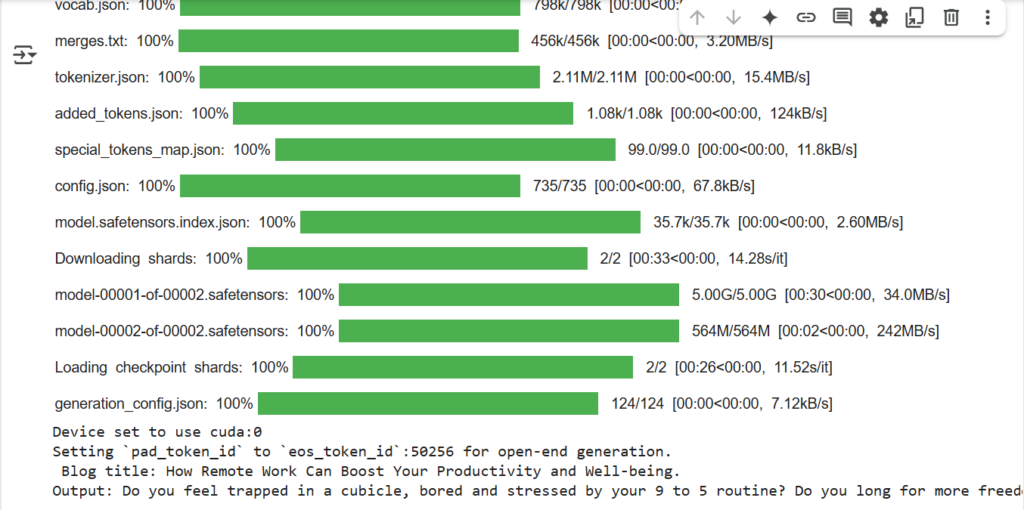 |
By adjusting parameters like max_new_tokens and temperature, we can influence the length and style of the output.
Parallel Token Processing and Context Length
One of the strengths of Transformer models is their ability to process multiple tokens simultaneously, unlike traditional sequential models.
Each token follows its own computation stream, with interaction occurring during attention steps. However, models have a context length limit, which defines the maximum number of tokens they can process at once (e.g., 4K tokens for some models).
If the input exceeds this limit, older tokens are truncated, potentially affecting output quality.
For example, let’s examine the processing of a simple prompt:
import torch

from transformers import AutoModelForCausalLM, AutoTokenizer

# Load model and tokenizer

tokenizer = AutoTokenizer.from_pretrained("microsoft/Phi-2")

model = AutoModelForCausalLM.from_pretrained("microsoft/Phi-2", device_map="auto", torch_dtype=torch.float16)

# Define the prompt

prompt = "The capital of Turkey is"

input_ids = tokenizer(prompt, return_tensors="pt").input_ids.to("cuda")

# Extract model outputs

model_output = model.model(input_ids)

lm_head_output = model.lm_head(model_output[0])

print("Model output shape:", model_output[0].shape)

print("LM head output shape:", lm_head_output.shape)
Output:
 |
Here, model_output[0].shape indicates that the input batch has one sequence of six tokens, each represented by a 3,072-dimensional vector.
The lm_head_output.shape shows that the model is predicting a probability distribution over 32,064 possible tokens for each position in the sequence. This demonstrates how each token undergoes complex processing before contributing to the final output.